
The jack that came with your 4WD was sized for the vehicle as it left the factory. Add bigger tyres, a lift and a load, and it can run out of reach before the wheel leaves the ground.
Quick picks
- Stock height tourer: Kincrome 4,000kg bottle jack and a base plate.
- Lifted 4WD on bigger tyres: a bottle jack with the Roadsafe Ram Extension Pack.
- Ruts, rocks and solo recovery: Hi-Lift All-Cast 48 inch, if you have steel bar work or sliders.
- Sand and mud: Bushranger X-Jack exhaust jack.
- Ute with tub or canopy space: RAXAR off-road trolley jack.
Most experienced tourers carry two: a bottle jack for tyre changes and a second jack matched to the terrain they drive most.
Jump to: Jack types · What to look for · Comparison table · The jacks · Bases and extensions · Safe jacking · FAQ
The four types of 4WD jack
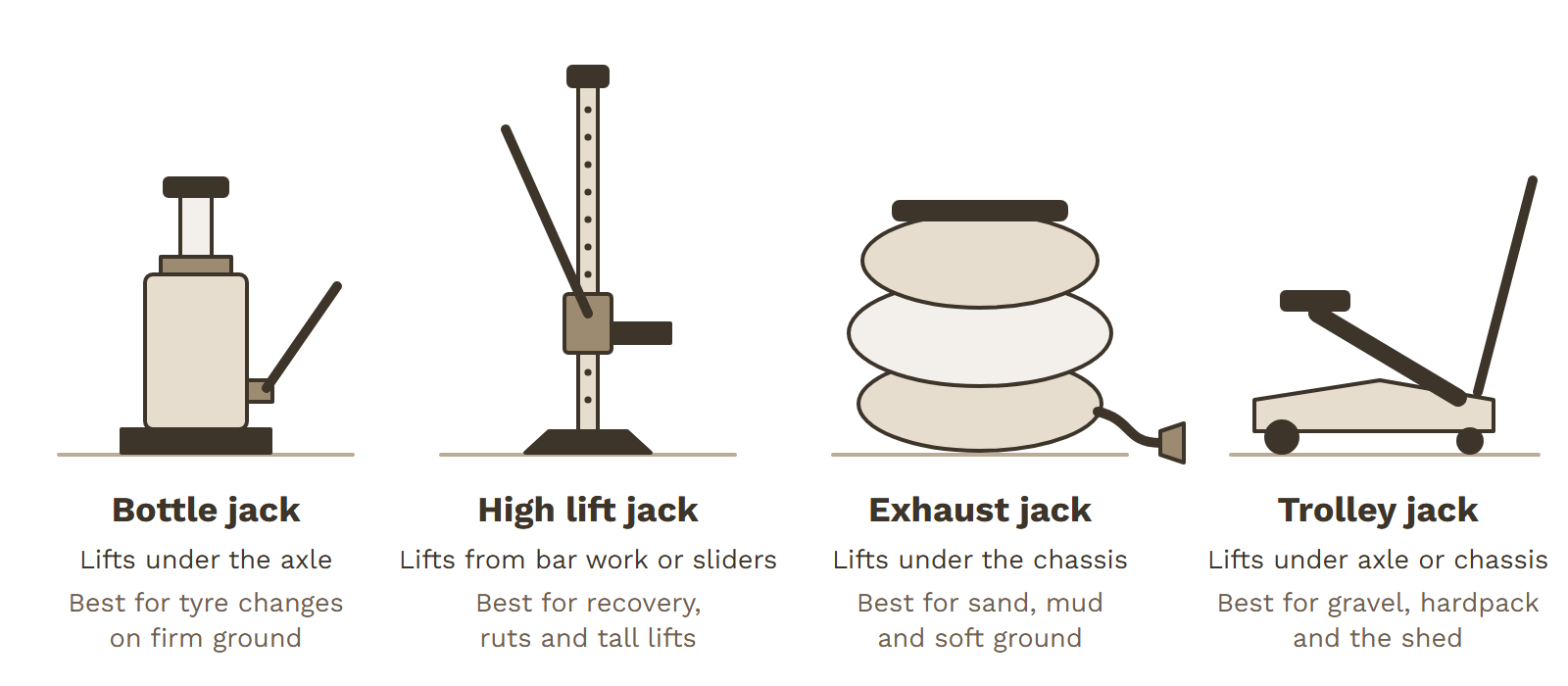
| Type | Good at | Weak at |
|---|---|---|
| Bottle | Strong, compact, lifts under the axle | Short reach, small base sinks on soft ground |
| High lift | Over a metre of lift. Also winches, clamps and spreads | Least stable. Needs a rated steel lift point |
| Exhaust | Wide footprint that works on sand and mud | Not for every exhaust, and not for hard, sharp ground |
| Trolley | Most stable and easiest to use | Bulky and heavy to carry |
What to look for
1. Lift range, measured on your vehicle
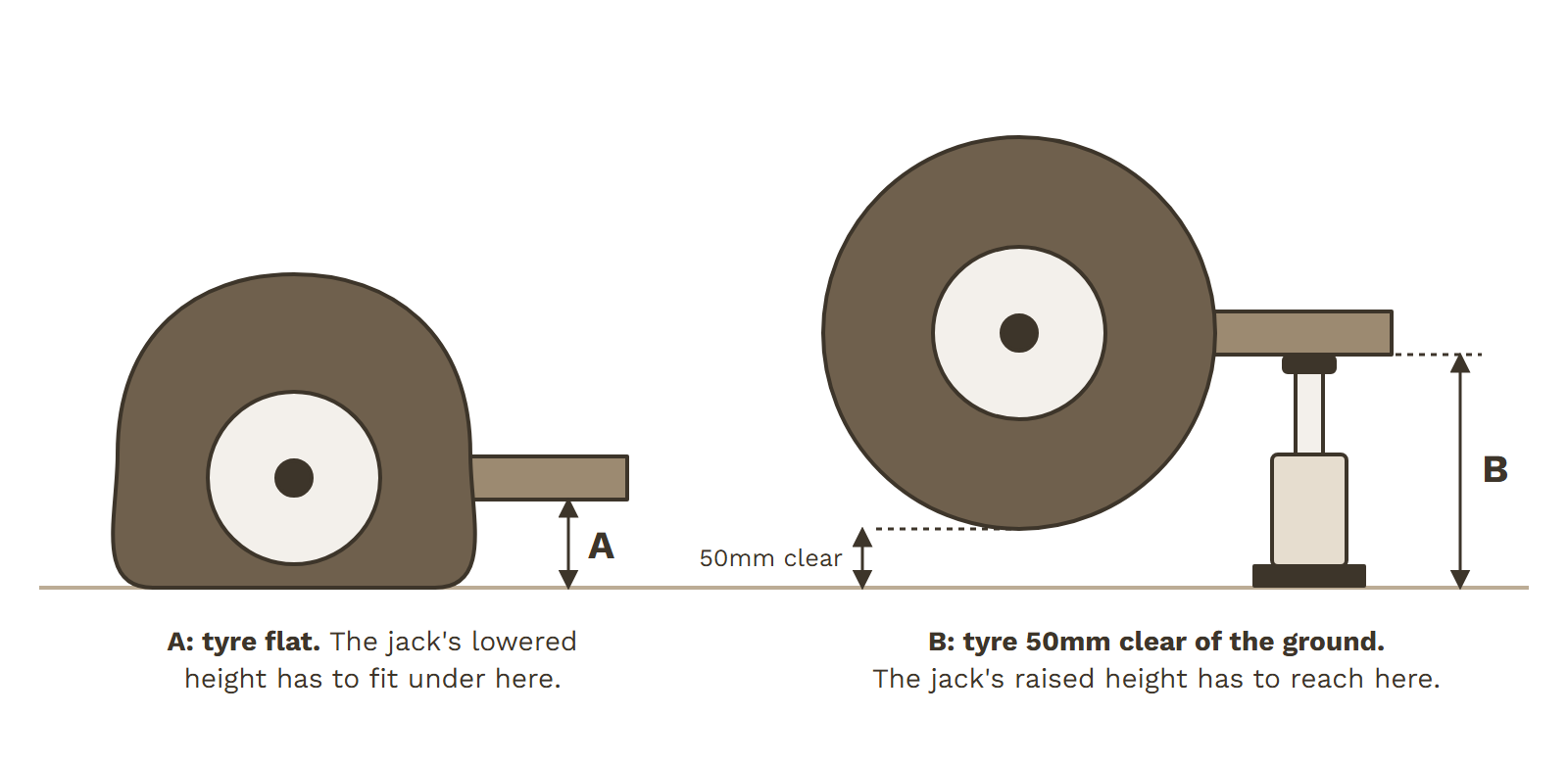
- Raised height: measure from the ground to your jacking point with the tyre inflated, then add 50mm.
- Lowered height: the jack has to fit under the same point with the tyre flat.
- Example: a 33 inch tyre is 838mm tall, so the axle centre sits about 419mm up. The jack needs to reach roughly 430mm. A bottle jack that tops out at 392mm will not do it without an extension.
2. The ground it will stand on
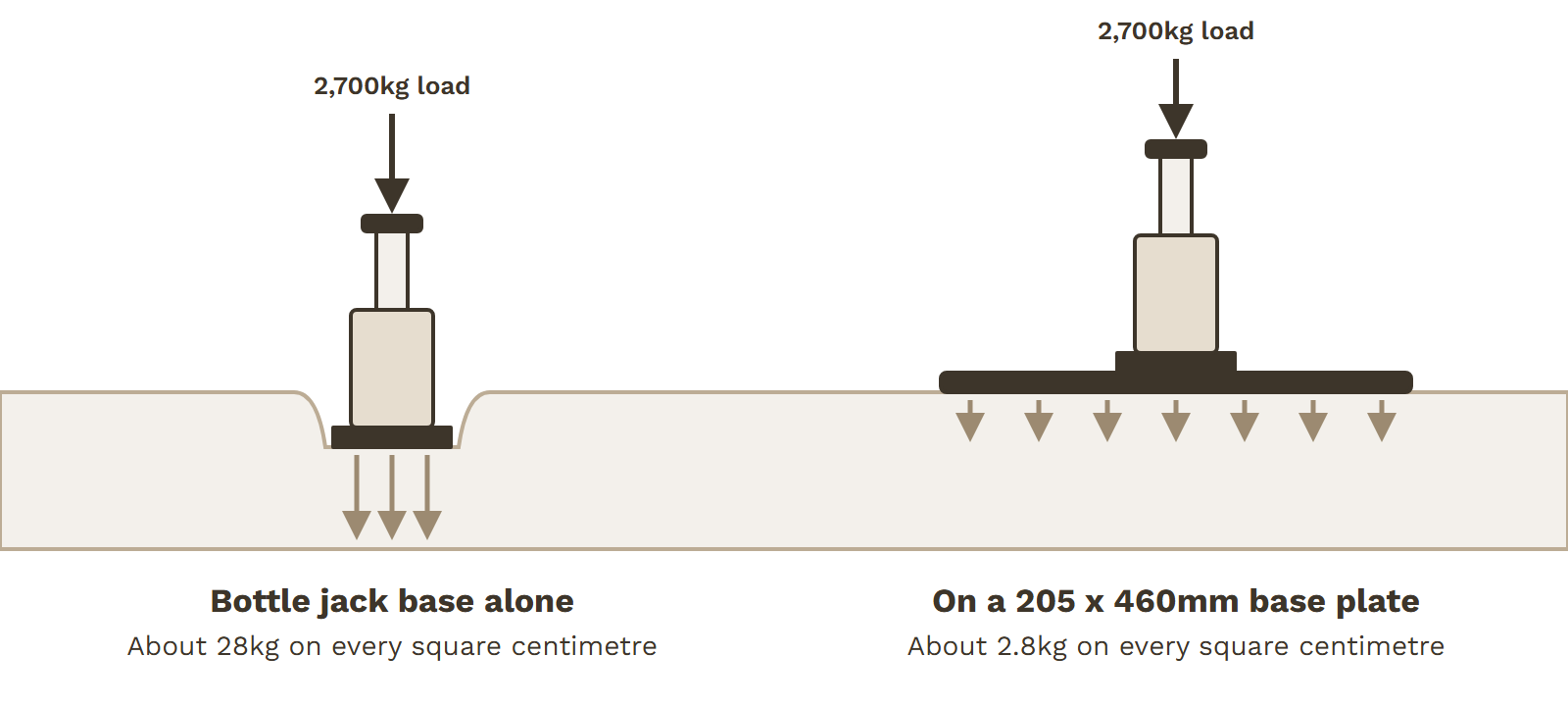
Roadsafe's example: a bottle jack lifting 2,700kg loads the ground at about 28kg per square centimetre. On a 205 x 460mm base plate that drops to about 2.8kg. On sand, carry a base.
3. Working load limit
A jack lifts one corner, not the whole vehicle, but one rear wheel of a loaded tourer can still put around 1,000kg on it. Buy with margin.
4. Where it lifts from
Bottle and trolley jacks go under an axle, spring seat or chassis rail. A high lift jack needs a steel bar, slider or rated point. Plastic bumpers and factory side steps are not lift points.
5. The Australian standard
Vehicle jacks sold in Australia fall under a mandatory safety standard based on AS/NZS 2693. Look for the standard and a marked working load limit.
Best 4WD jacks compared
| Jack | Type | Rated load | Lift range | Weight | Standard listed |
|---|---|---|---|---|---|
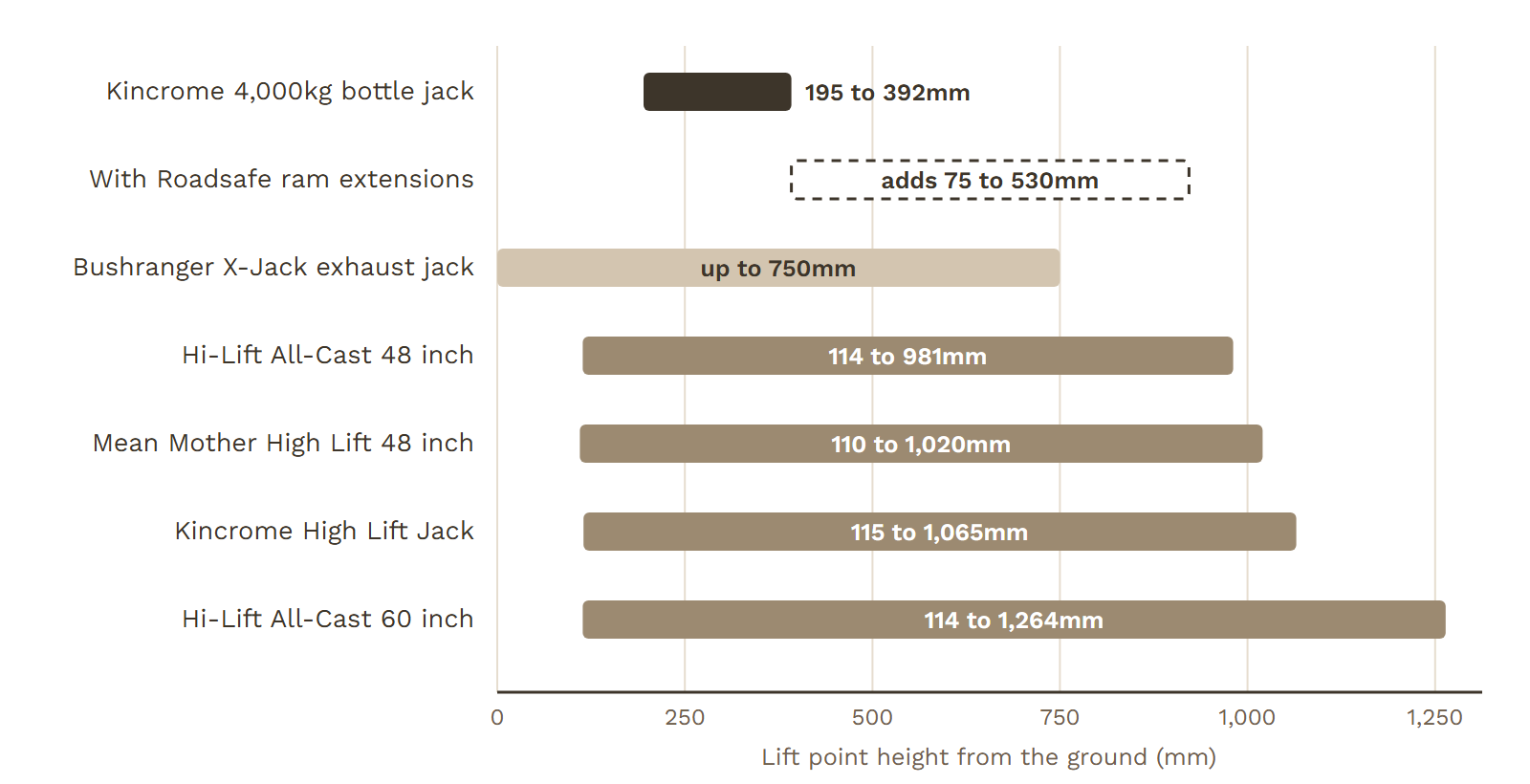
| Kincrome Hydraulic Bottle Jack 4,000kg | Bottle | 4,000kg | 195 to 392mm | 4.3kg | AS/NZS 2693:2007 |
| Hi-Lift All-Cast 48 inch | High lift | 2,113kg | 114 to 981mm | 12.77kg | ASME B30.1-2015 |
| Hi-Lift All-Cast 60 inch | High lift | 2,113kg, or 1,206kg on the top 305mm | 114 to 1,264mm | 14.2kg | ASME B30.1-2015 |
| Hi-Lift X-TREME 48 inch | High lift | 2,113kg | 114 to 981mm | 12.77kg | ASME B30.1-2015 |
| Mean Mother High Lift Jack 48 inch | High lift | 1,500kg | 110 to 1,020mm | not listed | AS/NZS 2693:2007 |
| Kincrome High Lift Jack 2,000kg | High lift | 2,000kg | 115 to 1,065mm | not listed | AS/NZS 2693:2007 |
| Bushranger X-Jack | Exhaust | 2,000kg | Up to 750mm | 5.4kg, 8.6kg as a kit | not listed |
| RAXAR Hydraulic Off-Road Trolley Jack | Trolley | 2,000kg | not listed | not listed | not listed |
The best 4WD jacks, type by type
Best bottle jack: Kincrome Hydraulic Bottle Jack 4,000kg

- 4,000kg rating, 195 to 392mm, 4.3kg
- Fully welded body, double seals, 120 x 110mm billet steel base
- Catch: 392mm is short on big tyres and the base sinks in sand
- Best for: stock height and mildly lifted 4WDs on stock or near stock tyres
Best fix for a lifted 4WD: Roadsafe Ram Extension Pack

- 75mm, 150mm and 225 to 305mm extensions, up to 530mm stacked
- Flat and axle top plates, carry bag included
- The jack stays flat on the ground, which is far safer than timber under the base
- Catch: fits rams from 28 to 35mm. Measure yours first, larger rams need an adaptor
- Best for: anyone with a 50mm or bigger lift who wants to keep a bottle jack
Best high lift jack: Hi-Lift All-Cast 48 inch

- 2,113kg rated load, tested to 3,175kg. The highest rating of the high lift jacks here
- 114 to 981mm lift, 12.77kg, all-cast iron
- 2,268kg winching capacity. The 60 inch version reaches 1,264mm
- Catch: on the 60 inch, the rating falls to 1,206kg on the top 305mm of the bar
- Best for: 4WDs with steel bar work or sliders on ruts, rocks and remote tracks
Best for recovery work: Hi-Lift X-TREME 48 inch

- Same body, rating and lift as the All-Cast
- Top attachment winches, clamps and spreads to 2,268kg, against 340kg clamping on the standard jack
- Also in a 60 inch version
- Catch: as a jack, it lifts no better than the All-Cast
- Best for: solo and remote travellers who want one tool for several recovery jobs
Best value high lift jack: Mean Mother High Lift Jack 48 inch

- 1,500kg rating, 110 to 1,020mm lift
- Lifts, winches, clamps, pulls and pushes. Complies with AS/NZS 2693:2007
- Catch: the lowest rating in this guide, so less margin on a heavy tourer
- Alternative: the Kincrome High Lift Jack is rated to 2,000kg and lifts 115 to 1,065mm
- Best for: lighter 4WDs and occasional recoveries
Best for sand and mud: Bushranger X-Jack
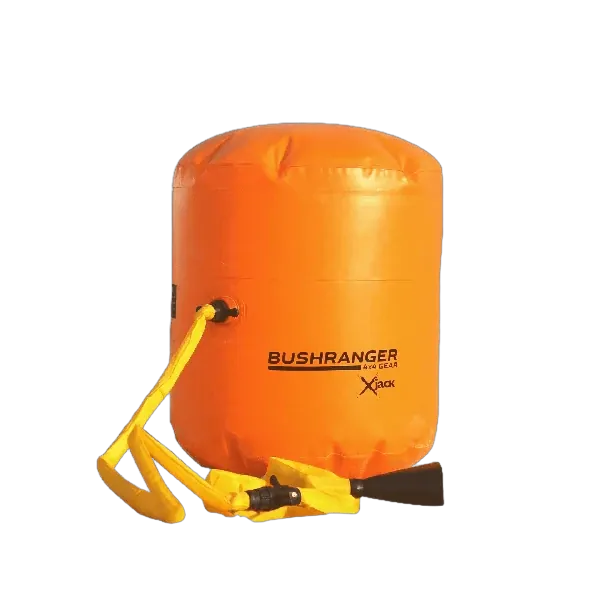
- 2,000kg lift, 750mm inflated height, 650mm diameter, 5.4kg
- Fills from the exhaust or a 12V air compressor
- Kit includes hoses, compressor adaptor, protective mat, gloves and bag
- Catch: not for vehicles over 4 tonne GVM. Exhaust filling does not work on dual or acute angle exhausts, including the LandCruiser 80 and 100 Series and Patrol GU. Use the compressor on those
- Best for: beach and desert drivers lifting a bogged vehicle to get boards under the wheels
Best trolley jack: RAXAR Hydraulic Off-Road Trolley Jack 2000kg
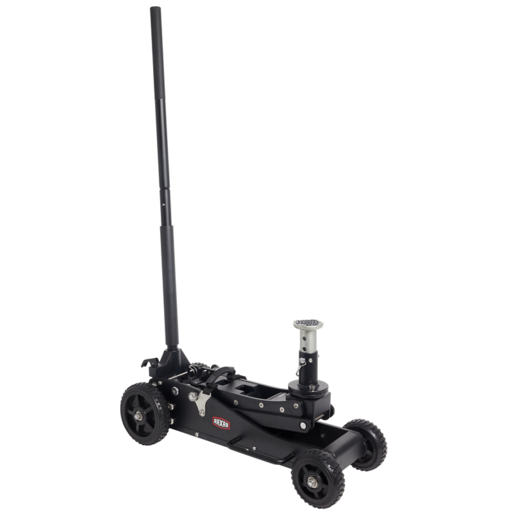
- 2,000kg capacity with a full-length steel skid plate for gravel
- 1,200mm 2-piece handle, reinforced lifting arm, rubber saddle insert
- Catch: the bulkiest jack here, and it still needs a board on soft sand
- Best for: utes with tub or canopy space, and a proper jack for the shed
Bases and extensions worth carrying
- Roadsafe Jack Base Plate 205 x 460mm: 940 square centimetres under a bottle jack, with sled ends and handles.
- Mean Mother High Lift Jack Sand Base: a wider foot for a high lift jack on sand, mud and dirt.
- MAXTRAX Mini and Jaxbase combo: a 2.2kg reinforced nylon jack base with a Mini recovery board that stacks on top.
- Hi-Lift Bumper Lift: hooks a Hi-Lift onto most curved steel bumpers. Rated to 1,361kg.
Towing a van? It needs its own jack. See the chassis mounted KoJack 4T High Lift kit or the Lil Rippa Jack 3.0 for off-road caravans.
Safe jacking on the track
The ACCC has linked around 160 accidents a year to vehicle jacks.
- Stop on the flattest, firmest ground you can reach.
- Handbrake on, in gear or park.
- Chock the wheel diagonally opposite, front and back.
- Base plate under the jack on anything softer than hard dirt.
- Loosen the wheel nuts before the tyre leaves the ground.
- Slide the spare under the chassis as a backstop.
- Never get under a vehicle that is only held up by a jack.
Common questions
What is the best jack for a lifted 4WD?
A bottle jack with ram extensions and a base plate. It stays under the axle, so the suspension lift does not use up its travel. The Roadsafe Ram Extension Pack adds 75mm to 530mm.
Are high lift jacks safe?
Yes, on a rated lift point, on a base, with the vehicle chocked and nobody under it. They are the least stable type, so use a bottle jack for wheel changes where you can.
What size bottle jack do I need for a 4WD?
Capacity is rarely the limit. A 4,000kg bottle jack covers any touring 4WD. Check the height: it has to fit under the jacking point with a flat tyre and lift an inflated tyre 50mm clear.
Do exhaust jacks work with any exhaust?
No. The Bushranger X-Jack will not fill from dual or acute angle exhausts, including the LandCruiser 80 and 100 Series and Patrol GU. Use the supplied compressor adaptor on those vehicles.
48 inch or 60 inch high lift jack?
48 inch suits most 4WDs and is easier to carry. The 60 inch reaches 1,264mm for tall vehicles, but on the Hi-Lift the rated load drops to 1,206kg on the top 305mm of the bar.
Shop 4WD jacks High lift jacks Trolley jacks Recovery kits
Load ratings, lift heights and weights are as listed by each manufacturer. Always read the instructions supplied with your jack and your vehicle's handbook for the correct jacking points.
