
5 Things to Do Before Your Next Trip
Most trips that go sideways were lost in the driveway, not on the track. These five things take a weekend, not a fortnight.
.webp)
It is worth knowing what goes wrong out there. RACQ research found only about a third of motorists (34.8%) get their car to a mechanic before a road trip, and in 2023 its patrols helped more than 738,000 drivers, mostly for flat batteries and flat tyres (RACQ). Two problems, both completely avoidable with an hour in the driveway. Start there.
1Give your rig a proper once-over
If your service is near due, get it done before you leave, not after. RACQ found nearly one in three Queenslanders put off essential car maintenance, which is exactly how a small issue becomes a breakdown 400km from the nearest town.
You can do the rest yourself. Check tyre pressure and tread on all four plus the spare. The legal minimum is 1.5mm of tread across the contact area, and underinflated tyres build dangerous heat on a long, loaded run, which is how a sidewall lets go at highway speed. Check your oil and coolant, look over your belts and hoses, and test the battery if the car has been slow to start. A flat battery is the single most common reason people end up stranded.
Then plan for the day the prep is not enough. Even a sorted rig gets bogged on soft sand or a greasy clay climb. Carry rated recovery points, a snatch strap, traction boards and a shovel, and know that a tow ball is not a recovery point. It becomes a projectile under load. A recovery kit turns a two-hour bog into a ten-minute one. This matters most if you travel solo or head anywhere remote.
Shop Recovery Equipment ›.webp)
2Sort your power before the fridge does it for you
Nothing kills the mood like opening the fridge on day two to warm food and a flat battery. Power problems are slow and quiet until they are not, so test your setup before you leave instead of finding the limit out bush.
Charge your dual battery or portable power station fully, then actually test it. Run the fridge off it overnight at home and check the voltage in the morning. If it cannot hold a fridge through one night in the driveway, it will not hold it through three in the heat. Pre-cool the fridge at home the night before too, so it is not pulling hard to drop from ambient on your first day.
For longer or remote trips, a solar panel keeps you topped up without idling the car, and a 12V fridge on a healthy battery system is the difference between fresh food and a soggy esky. This is the setup to get right if you are away for more than a weekend or camping without mains power.
Shop Batteries & Power ›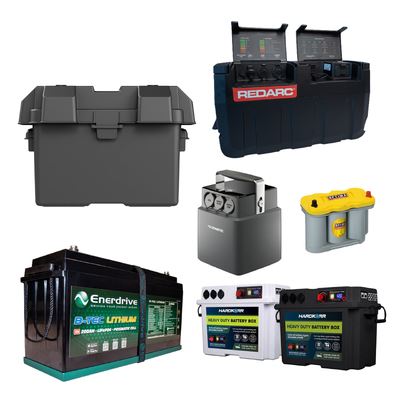
3Plan how you'll call for help
Before you go anywhere with patchy coverage, tell someone your route and your expected arrival time. RACQ makes the same point: leave your plan with a family member or friend, and do not count on always having mobile reception. Coverage drops off fast once you leave the highway.
A UHF radio covers you for convoy travel and busy tracks, where announcing your position on the highway channel can stop a head-on on a single-lane climb. For genuinely remote travel, carry a Personal Locator Beacon. When it is activated, it gives search and rescue your exact position even where there is no phone signal at all.
One step people skip: register the beacon. Registration with the Australian Maritime Safety Authority is free, and since November 2024 it no longer expires. A registered beacon lets AMSA call your emergency contacts and start a response straight away, where an unregistered one slows everything down. Five minutes online now buys you a faster rescue later.
Shop Navigation & Comms ›4Pack more water than you think you need
Water is the one thing you cannot improvise out there. Plan for several litres per person per day for drinking, then add more for cooking and washing, and more again in the heat. It adds up faster than people expect on a hot run with a couple of kids in the back.
Do not plan around finding water on the way. Many outback tanks are unreliable, and plenty are signed as not for drinking. Carry what you need with you. Spread it across more than one container too, so a single split jerry can does not cost you the whole supply. A mix of rigid jerry cans and a packable bladder gives you flexibility for how you load and where it sits.
Shop Water Storage ›5Do a full dry run of your setup
This is the one nobody does and everyone wishes they had. Set your whole camp up once, at home, before the trip. Pitch the swag or tent in the backyard. You want to find the missing pole, the snapped peg or the zip that has given up while you are standing on your own lawn in daylight, not at 9pm in the dark with the kids tired and the rain coming in.
Run the fridge off your battery overnight (the same test from step two), check your camp lights and head torch actually work, and swap any flat batteries now. Then lay everything out and pack to a written list the night before you leave, not on the morning of, when the excitement kicks in and things get left on the bench. One quiet run-through the night before catches almost everything.
Shop Tents & Swags ›Your pre-trip checklist
Tick these off before you back out of the driveway.
- Vehicle once-over. Service if due, tyres and spare (1.5mm tread minimum), fluids, battery tested, recovery kit packed.
- Power tested. Battery charged and proven overnight, fridge pre-cooled, solar packed for longer trips.
- Comms sorted. Route and ETA left with someone, UHF on board, PLB carried and registered with AMSA.
- Water carried. Several litres per person per day, split across containers, independent of finding any on the way.
- Camp dry run. Tent or swag pitched at home, lights checked, everything packed to a list the night before.
Frequently asked questions
How far ahead should I check my vehicle?
At least a week out. A check the night before only tells you something is wrong. A check a week out gives you time to book a service, order a part or replace a tyre before you leave. Battery and tyre faults are the two most common reasons people break down, and both are easy to catch early.
Do I really need a PLB if I have a phone?
Once you leave main roads, mobile coverage thins out quickly, and a phone is useless with no signal or a flat battery. A Personal Locator Beacon works on a satellite network where phones cannot reach. Carry one for remote travel, and register it with AMSA. Registration is free and means a faster response if you ever set it off.
How much water should I carry?
Plan for several litres per person per day for drinking alone, then add more for cooking, washing and hot weather. Carry it with you rather than relying on tanks along the way, and split it across more than one container so a single leak does not leave you short.
Sources: RACQ vehicle and road-trip research; Australian Maritime Safety Authority beacon registration. General information only. Always check your vehicle handbook, tyre placard and current state fire and road conditions before you travel.
