
.png)
This is a question we hear a lot: will this connect to my compressor? It comes up on hose reels, on the Pressure Pilot, and on the multi tyre deflator kits, and it always comes back to the same thing. Two air fitting standards are in common use in Australian 4WDs, and the ARB/Nitto air fittings question decides whether your gear plugs together or sits in the drawer.
The good news is that it is simpler than it looks. For most setups the fitting standard only has to be decided at one point. Here is how it works, what is on each piece of Tuff Terrain gear, the one product that breaks the pattern, and the thread trap that catches people out even when the couplers match.
First, the Two Halves of a Fitting
Almost every ordering mistake starts with mixing up these two words, so it is worth thirty seconds.
The plug (also called the adaptor or nipple) is the male half. It pushes into the other side. This is usually what sits on your air hose, gauge, deflator kit or blow gun.
The coupling (also called the socket) is the female half with the sliding collar. You pull the collar back, push the plug in, and release to lock it. This is usually what sits on your compressor or hose reel. One touch couplings skip the collar pull, so you just push the plug straight in.
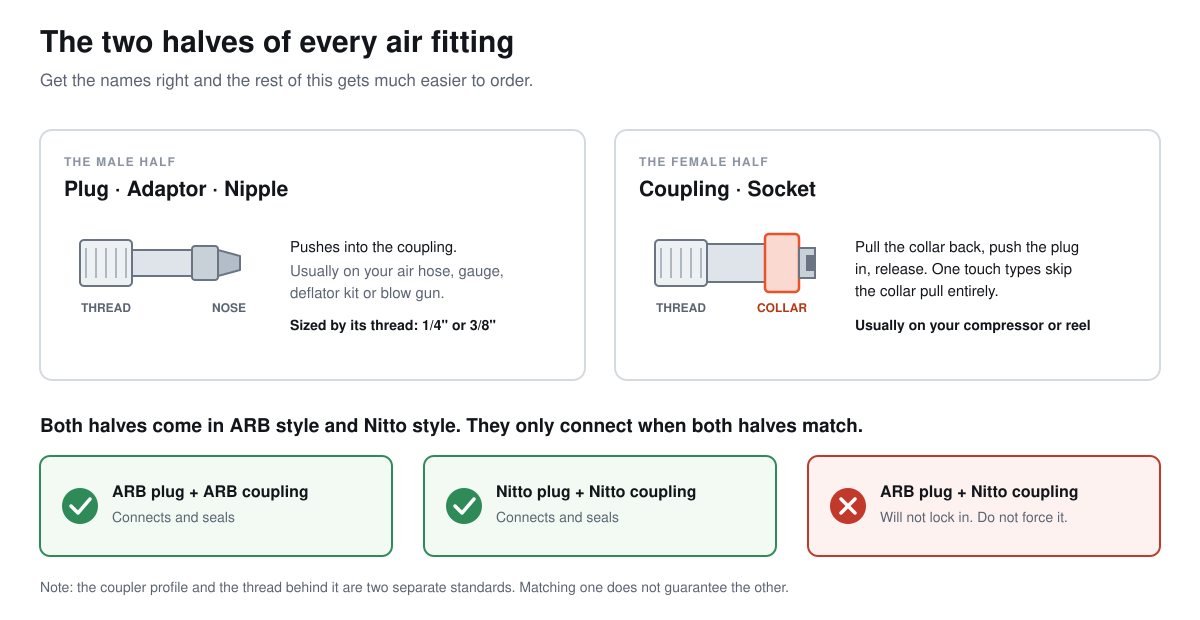 Both halves come in ARB style and Nitto style. They only connect when both halves match.
Knowing which half you are looking at matters here. A product spec that says "female couplings" is telling you about the sockets other things plug into, and that is often the downstream side of the unit.
Behind both halves is a thread, and that is a separate standard again. A fitting can have exactly the right coupler profile and still refuse to screw into your compressor. More on that below, because it is the mistake that costs people a port.
Where Each Standard Comes From
Nitto style is an industrial standard & it is what most general purpose compressed air equipment is built around. That is why most air tools, blow guns and workshop hoses arrive with a Nitto style connection on them, and why it is made under a long list of names like "Nitto style", "Nitto equivalent" etc.
The ARB coupling came out of the American market and arrived here with ARB's air systems. In the Australian 4x4 industry specifically it is very common, and this popularity has pulled the rest of the industry along with it, which is why you will find ARB style fittings on a lot of 4x4 equipment from non-ARB branded products.
So the two come from different worlds and both are common in a 4WD. General industrial air gear tends to be Nitto. Dedicated 4x4 air gear is very often ARB. Our own range reflects that: most of the Tuff Terrain air accessories are set up for ARB as supplied, with the compressors being the exception.
The Rule That Makes This Simple
For most setups, the fitting standard only has to be decided at one point: the line out from the compressor.
That single connection, where air leaves the compressor and enters the rest of your system, is where the two standards have to agree. Once you have made that decision, most of what sits downstream is supplied to match, so you are not choosing again at every joint.
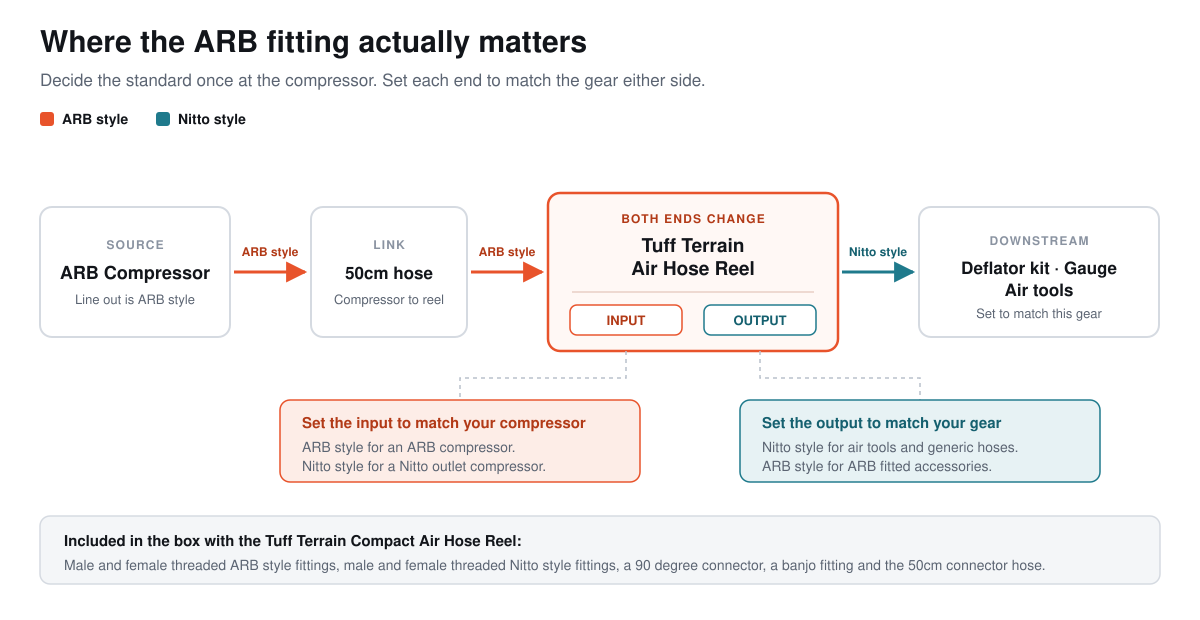 The decision that matters is at the compressor outlet. The hose reel lets you set both ends to suit.
A very common Australian setup runs an ARB Twin High Output Air Compressor with an ARB fitting at the outlet, then Nitto from there on so that generic air tools and hoses plug straight in. That is a sensible way to build it. It is not the only way, and it is not compulsory.
Quite often people assume the fitting standard has to be consistent through the whole vehicle. It does not. It has to be consistent at each connection point.
What Fitting Is on Your Tuff Terrain Gear
| Product | What it comes with |
|---|---|
| Tuff Terrain V4 400LPM High Output Air Compressor (digital and analogue gauge) | Twin 1/4" Nitto style fitting outlets. The fitting itself is changeable, so an ARB setup is still workable, it just needs the fitting swapped. |
| Tuff Terrain Pressure Pilot (control unit, 2 tyre and 4 tyre kits) | Comes fitted with ARB female couplings and an ARB male coupling. One extra Nitto male fitting is included. See the note below. |
| Tuff Terrain Multi Tyre Deflator/Inflator Kit (2 and 4 valve) | Air connections suit an ARB style compressor and fittings. Includes an add-on 3/8" Nitto style fitting for standard compressors. |
| Tuff Terrain Compact Air Hose Reel (7m, 12m and self retracting) | Both standards supplied so you can change either end as needed: male and female threaded ARB style fittings, male and female threaded Nitto style fittings, plus a 90 degree connector, a banjo fitting and a 50cm connector hose. |
| Tuff Terrain Premium Quick Connect Digital Air Gauge | 60cm hose with a 1/4" Nitto style fitting. |
| Tuff Terrain Hose Extension | 6.5m of hose with two female quick connect Nitto style fittings, plus a male side Nitto fitting with a 1/4" male thread and another with a 1/4" female thread. |
The two questions we hear most
"I have a Tuff Terrain compressor and a Pressure Pilot, and they will not connect." Correct, straight out of the boxes they will not. The compressor outlets are Nitto style and the Pressure Pilot arrives fitted for ARB. Fit the spare Nitto male fitting that came in the Pressure Pilot case and it connects.
"I have an ARB compressor and a Tuff Terrain deflator kit, do I need an adapter?" No. The deflator kits are built to suit an ARB style compressor as supplied, so it connects as is. The 3/8" Nitto style fitting in the box is the part you would fit if you later moved to a non ARB compressor. If you have lost it, the Nitto Style 3/8" Male Plug Fitting is the same part sold on its own.
The Thread Trap: BSP vs NPT
The coupler profile is only half the story. The other half is invisible until you try to screw something in, and it is where people do real damage.
In the Australian 4WD market the pattern is fairly consistent. General purpose air fittings sold here are BSP, and the Nitto equivalent adaptors are 1/4" BSP. ARB compressor side hardware is typically NPT. If you are ordering a quick connect coupler, those are pretty safe assumptions and they cover the large majority of setups.
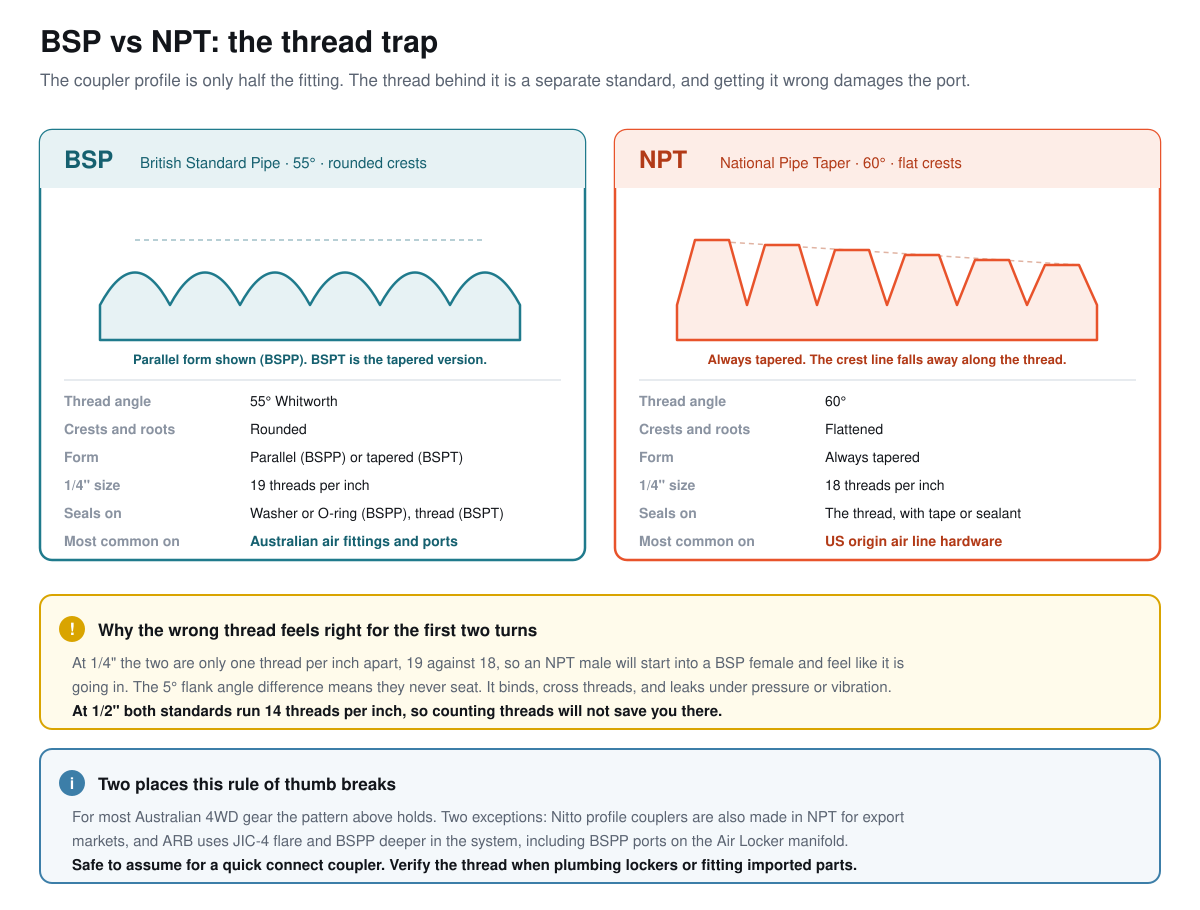 At 1/4" the two standards are only one thread per inch apart, which is why the wrong one feels right for the first two turns.
The numbers explain the problem. At 1/4", BSP runs 19 threads per inch and NPT runs 18. One thread apart. So an NPT male will start into a BSP female and feel like it is going in. What stops it seating is the flank angle: BSP uses a 55 degree Whitworth form with rounded crests, NPT uses 60 degrees with flattened crests. Those five degrees mean the two never bed down against each other. It binds, cross threads, and leaks under pressure or vibration. In the worst case you have chewed out the port on a compressor.
So assume BSP for a general purpose fitting and NPT for ARB compressor hardware, but verify the thread when you are plumbing lockers, working on a manifold, or fitting anything imported. Use thread tape or sealant on the male thread when you assemble a tapered joint, because NPT and BSPT both seal on the thread itself rather than on a washer. Air systems typically leak at the thread far more often than at the coupler.
Sorting Your Fittings
If you are converting a system or building one, these are the parts that do the work.
- Converting a compressor outlet to Nitto. The Nitto Equivalent High Volume Male 1/4" BSP adaptor and the female 1/4" BSP version cover most conversions. Both are steel and both suit high volume two stage and one stage Nitto equivalent couplings.
- The coupling on the other end. The Jamec Pem 1/4" BSP Male High Volume One Touch Coupling is a steel one touch design, so you push the plug straight in without pulling the collar back first. That is worth more than it sounds when you are doing four tyres with cold hands.
- Adapting a deflator kit. The Nitto Style 3/8" Male Plug Fitting adapts a Tuff Terrain Multi Tyre Deflator/Inflator to a regular Nitto style fitting.
- Reaching the far tyres. The Tuff Terrain Hose Extension adds 6.5m and splices into a Nitto system without extra parts.
- Keeping grit out. An open female coupler in an engine bay or rear bar collects dust, and grit is what chews out the internal seal. Cap or plug it when it is not in use.
The Verdict
If you run an ARB compressor: keep ARB at the compressor outlet. Set your hose reel input to ARB and its output to whatever the gear you plug in uses. Your Pressure Pilot and deflator kit already suit an ARB source as supplied, so there is nothing extra to buy.
If you run a Tuff Terrain or other Nitto outlet compressor: you have two options. Swap the compressor outlet fitting to ARB and let the rest of the range connect as delivered, or keep the compressor on Nitto and fit the spare Nitto fittings supplied with your Pressure Pilot, deflator kit or hose reel. Both work. The second is fewer parts if your other gear is mostly Nitto already.
Either way, carry a spare. One spare fitting for your source connection lives in the recovery bag and weighs nothing. A stripped fitting 400km from the nearest town turns a good compressor into dead weight.
The Bottom Line
- Nitto is the industrial standard, so general air tools and workshop gear use it. ARB is very common on dedicated 4x4 air systems in Australia.
- For most setups you only decide the standard once, at the line out from the compressor.
- The Pressure Pilot is the exception. Its couplings are ARB as supplied, and the one spare Nitto fitting converts the input only.
- Tuff Terrain compressors have twin 1/4" Nitto style outlets, and the fitting is changeable if you want ARB.
- The hose reels include both standards in male and female, so you can change either end as needed.
- Expect BSP on general purpose fittings and NPT on ARB compressor hardware. BSP is 55° and 19 TPI at 1/4"; NPT is 60° and 18 TPI. They will start threading together and then bind.
Browse the full range of air compressor hoses and accessories to sort your fittings, or the wider air compressors and tyre maintenance range if you are building a system from scratch. For fitting series specifications, Jamec Pem publish flow and pressure data across their airline range, and ARB document their own air system hardware.
FAQ
Can I connect an ARB fitting directly to a Nitto fitting?
No. The coupler profiles are different shapes, so a Nitto plug will not lock into an ARB coupling and an ARB plug will not lock into a Nitto coupling. You either fit an adapter between them, or change one end so both sides match. Changing the fitting is tidier long term, because an adapter is one more joint that can leak and one more part to lose.
Which fitting does my Tuff Terrain air hose reel use?
Both standards are supplied with the reel so you can change either end as needed. In the box you get male and female threaded ARB style fittings, male and female threaded Nitto style fittings, a 90 degree connector, a banjo fitting and a 50cm connector hose. Match the input to your compressor and the output to the gear you plug into it.
Why will my Tuff Terrain compressor not connect to my Pressure Pilot?
Because the Pressure Pilot comes fitted with ARB couplings and the Tuff Terrain compressor outlets are 1/4" Nitto style. The Pressure Pilot includes a spare Nitto male fitting in the case for exactly this. Fit it and the two connect.
Does the Pressure Pilot run Nitto once it is connected?
No. As supplied, its female couplings, which are the connections on the unit, are ARB. The single spare Nitto male fitting converts the input so a Nitto compressor can feed it. That fitting does not convert the rest of the unit, so if you want the Pressure Pilot on Nitto throughout you will need additional fittings. Check the unit you have before ordering anything to go with it.
Do I need an adapter to run a Tuff Terrain deflator kit on an ARB compressor?
No. The Multi Tyre Deflator/Inflator kits are supplied with air connections to suit an ARB style compressor and fittings, so it connects as delivered. The 3/8" Nitto style fitting included in the box is there for when you are running a standard compressor instead.
How do I tell BSP and NPT apart if nothing is marked?
Count the threads. At 1/4" size, BSP runs 19 threads per inch and NPT runs 18, so a thread gauge or a careful count over an inch will separate them. The thread form is the other tell: BSP crests are rounded, NPT crests are flattened. Be careful at 1/2", where both run 14 threads per inch and counting will not help you. Where the joint matters, gauge it rather than assuming from the coupler brand, or take the part into a store and match it.
Does Nitto always mean BSP, and ARB always mean NPT?
Not always, but in the Australian 4WD market it holds most of the time. General purpose air fittings sold here are usually BSP, and ARB compressor side hardware is NPT, so for ordering a quick connect coupler those are safe assumptions. Two exceptions are worth knowing. Nitto profile couplers are also made in NPT for export markets. And ARB uses more than one standard deeper in the system, with JIC-4 flare on the braided hose and BSPP ports on the Air Locker manifold. Verify the thread when you are plumbing lockers or fitting imported parts.
Is Nitto better than ARB for air fittings?
Neither profile is technically superior for tyre work. Nitto is the industrial standard, so generic air tools, gauges and workshop hoses plug straight into it, and it is what a small town rural supplies store is most likely to have on the shelf. ARB is very common on 4x4 air systems here, so if your compressor and lockers are ARB, staying ARB keeps the system consistent. Pick the one that matches the most gear you already own.
What size fitting do I need, 1/4" or 3/8"?
That refers to the thread on the back of the fitting, not the coupler profile. Check what your compressor port or hose end is threaded for before ordering, and check the thread standard as well as the size. If you are unsure, take the old fitting into a store and match it rather than guessing.
Why does my air fitting leak even though it clicks in properly?
Nine times out of ten the leak is at the thread, not the coupler. Fittings screwed into a compressor or hose end need thread tape or sealant on the male thread, and people skip it. The other common cause is grit inside the female coupler holding the internal seal open. Blow it out and check the seal before replacing the fitting.
