My Car
Please select your vehicle
Enter your boat, the bottom you anchor on and the conditions you anchor in. You get the anchor weight, the chain and the rope, with every step of the working shown.
Enter your boat to see a result.
The baseline weight comes from the anchor maker's own boat length rating. The calculator adds four figures of its own: the boat type and conditions multipliers, a bow height allowance of 15 percent of boat length, and the scope ratio. All four are shown in the working above. Please note this is just a guide.
The baseline the calculator starts from, before it adjusts for your boat type and conditions. These are the anchor maker's own boat length ratings for the anchors we stock.
| Boat length | Sand anchor | Plough anchor | Chain | Rope |
|---|---|---|---|---|
| Up to 2m | 1.4kg | — | 6mm | 6mm |
| 2 to 3m | 1.8kg | — | 6mm | 6mm |
| 3 to 4m | 2.7kg | — | 6mm | 6mm |
| 4 to 5m | 3.6kg | 4.5kg | 6mm | 8mm |
| 5 to 6m | 4.5kg | 6.8kg | 6mm | 8mm |
| 6 to 7m | 5.9kg | 6.8kg | 6mm | 10mm |
| 7 to 8m | 7.3kg | 9kg | 8mm | 10mm |
| 8 to 9m | 10kg | 12kg | 8mm | 12mm |
| 9 to 11m | 12kg | 16kg | 8mm | 12mm |
| 11 to 13m | 16kg | — | 8mm | 12mm |
| 13 to 14m | 20kg | — | 10mm | 12mm |
Sand anchor sizes are often sold in pounds, so a 10lb anchor is 4.5kg and a 22lb is 10kg. A plough runs heavier than a sand anchor for the same boat because it holds by digging in rather than by fluke area.
This chart is for day anchoring in normal conditions. A cabin boat catches more wind than a tinny of the same length, and anchoring overnight or on an exposed coast asks a lot more of the anchor. That is what the calculator adjusts for.
Getting the type right matters more than getting the weight right. A heavy anchor that cannot bite is worse than a light one that can.
| Anchor | Best in | Poor in | Worth knowing |
|---|---|---|---|
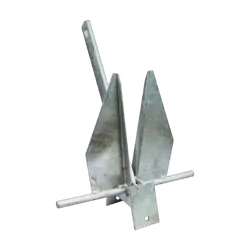
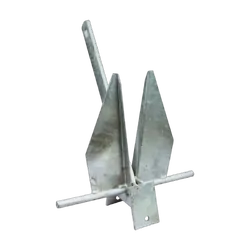
| Sand (Danforth) | Sand, mud | Reef, heavy weed | The most common trailer boat anchor. Big flat flukes, stows flat, cheap for the hold you get. Struggles to reset if the tide swings it. |
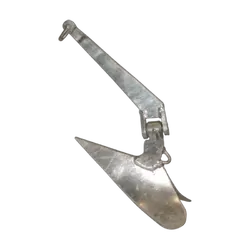
| Plough | Sand, mud, weed | Reef | Digs in rather than lying flat, so it resets well when the wind or tide turns. The pick for anchoring overnight. Needs a bow roller. |
| Delta | Sand, mud, weed | Reef | A one-piece plough with no moving parts. Sets fast and self-launches off a roller. |
| Reef | Reef, rock, rubble | Sand, mud | Sized by prong thickness, not weight. The prongs are meant to bend straight so you can pull it free instead of losing it. Bend them back afterwards. |
| Mooloolaba pick | Reef, rubble | Sand | A heavier reef anchor with a lead-weighted shank. Popular off south east Queensland. |
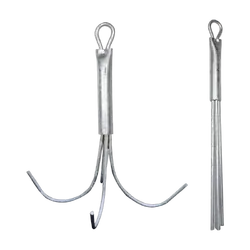
| Folding grapnel | Rubble, small craft | Anything with wind on it | For kayaks, tenders and holding a tinny off a bank. Not a boat anchor in any real breeze. |
Anchoring over reef, take the reef anchor. A sand anchor jammed in coral is usually a lost anchor, and cutting it free costs you the rope and chain as well.
The anchor is only half of it. What holds a boat is the rode, and the chain is the part doing the quiet work.
Chain does two jobs. Its weight pulls the pull on the anchor flat along the bottom instead of upward, which is what lets the anchor bite, and it takes the chafe on reef and shell where rope would part. Run at least one boat length of it. Anything less and in a blow you are lifting the shank rather than dragging the flukes in.
Rope gives you the stretch. Nylon takes the snatch out of a swell that would otherwise jerk the anchor out. Use three strand nylon, and buy more than you think you need, because you cannot let out scope you do not have.
| Conditions | Scope | Rode in 6m of water | Rode in 15m of water |
|---|---|---|---|
| Sheltered river or estuary | 5:1 | 35m | 80m |
| Open bay, day anchoring | 6:1 | 41m | 95m |
| Exposed coast, or overnight | 7:1 | 48m | 111m |
Scope is the total length of chain and rope you let out, divided by the depth. The figures above are for a 5.5m boat, so they include depth plus 0.83m for the height of the bow roller above the water. Deeper water and a taller bow both need more rode.
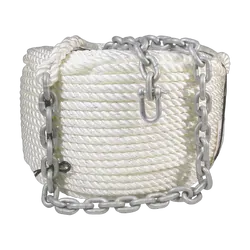
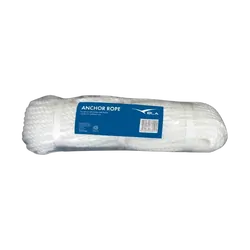
A spread across the range, from a tinny anchor to a full rode for a cabin boat.
As a starting point, a 4m boat needs about a 2.7kg sand anchor, a 5m about 3.6kg, a 6m about 4.5kg and a 7m about 5.9kg. Those are the anchor maker's own boat length ratings for day anchoring in normal conditions. Add weight from there if your boat has a cabin, if you anchor on an exposed coast, or if you leave it sitting overnight. The old rule of a pound of anchor per foot of boat gets you close for a plain open boat and undersizes everything else.
A 3.6kg sand anchor for a 5m open boat anchoring in sheltered water, moving to 4.5kg for a runabout in an open bay and 5.9kg for a half cabin anchoring overnight. In weed you would step across to a 4.5kg plough instead, and over reef to a 10mm reef anchor. The pattern holds for most trailer boats: the length sets the baseline, the cabin and the conditions decide how far above it you go.
Within reason, yes. Nobody has ever dragged because their anchor was too heavy, and one size up is cheap insurance for the nights you did not plan on. The limits are practical rather than technical. You have to lift it over the bow by hand, it has to fit the anchor well or the roller, and the weight sits right up in the bow where it hurts the ride most. Go one size up, not three.
At least one boat length, so 5m of chain on a 5m boat, and more is better. The chain is what keeps the pull on the anchor horizontal so the flukes dig in instead of being lifted out. It also takes the chafe on reef and shell. Size it to the anchor rather than the boat: up to about 6kg of anchor takes 6mm chain, 6 to 16kg takes 8mm, and above that 10mm.
Multiply the depth you anchor in by the scope you want, then take off the chain you are already carrying. Five to one is enough in a sheltered river, six to one in an open bay for the day, seven to one on an exposed coast or overnight. In 6m of water at six to one that is around 41m of rode all up, so with 6m of chain you want 35m or more of rope. Buy the longer hank. You cannot let out scope you did not bring.
Scope is how much rode you have out compared with the depth of water, measured from the bow roller rather than the waterline. It matters because an anchor holds by being pulled along the bottom, not up off it. At three to one the pull is steep enough to break most anchors out. At seven to one it is almost flat and the same anchor will hold through a lot of wind. More scope is the cheapest way to stop dragging, and it costs nothing but swinging room.
A reef anchor, and nothing else. The prongs are made from mild steel so they bend straight under load and let you retrieve it. A sand anchor or a plough wedged in coral generally stays there. Pair it with a few metres of chain, because rope over reef will chafe through faster than you would believe, and bend the prongs back with a shifter before the next trip.
A sand anchor is the cheaper and more common choice, holds very well in sand and mud for its weight, and stows flat in an anchor well. A plough costs more and needs a bow roller, but it digs in through weed and resets itself when the tide swings the boat around, which is why it is the one to have if you anchor overnight. Plenty of people carry both, a sand anchor for the day and a plough for when they stay.
It does, and anchors are still commonly sold in pounds. A 16 foot boat is about 4.9m, which is an 8lb or 3.6kg sand anchor at the baseline. An 18 foot is 5.5m and takes 10lb or 4.5kg, a 20 foot is 6.1m and takes 13lb or 5.9kg, and a 25 foot is 7.6m and takes 16lb or 7.3kg. Those are for an open boat in sheltered water, so size up from there for a cabin or for anchoring overnight. Enter the length in metres in the calculator and it will do the conversion for you.
Because what an anchor mostly fights is wind, not water. A half cabin or a flybridge presents a lot more side to a breeze than an open tinny of the same length, so the load coming down the rode is higher for the same conditions. Weight and windage go together as well, since the boat with the cabin is usually the heavier one. That is why the calculator asks what kind of boat it is rather than only how long it is.
Sizing baselines are the anchor manufacturer's own published boat length ratings for the products we stock, and chain sizing follows Lewmar's suggested chain size by anchor weight. Conditions vary and no chart can allow for every bottom, tide and blow, so treat the result as a starting point and go up a size if you are unsure. Prices and availability correct at time of publishing.

WITH HUMM
Shop up to $2,000.00 and pay only $61.54 per week for 6 months.
WITH UP TO 12 MONTHS TO PAY
Shop up to $3,000.00 and pay only $46.15 per week for 12 months.
All you need to qualify is:
1) To be over 18 years of age.
2) Be an Australian permanent resident.
3) Have a valid form of identification (Australian Drivers License; Aged Pension Card; or Veteran's Pension Card).
4) Payment Type in your name (credit, debit or bank account).
For more information and to get set-up today, call our local customer support team on 1300 854 185
*Minimum deposit of 20% required. Weekly payments are calculated on a rate excluding a 20% initial deposit. Terms and conditions apply.
{{rrp}}
RRP {{price}} SALE {{price}} MATES'