
.webp)
How to Choose the Right Camping Gas Stove for Australian Conditions
You have driven six hours to a campsite. The kids are hungry. The sun dropped behind the ridge 20 minutes ago. You pull out your stove, click the igniter, and nothing happens. The wind blowing off the gorge keeps killing the flame, and you are now standing in the dark holding a box of matches, questioning every decision that led you here.
That is the cost of choosing the wrong camping stove. The right one lights first time, holds a flame in a crosswind, and gets dinner on the table before the kids start eating dry two-minute noodles out of the packet. This guide covers what to look for before you buy, compares four camping gas stoves we stock, and answers the questions that come up on Australian camping forums.
What to Look For Before You Buy a Camping Gas Stove
Not every camping stove suits every trip. A solo hiker covering 20 km a day needs something fundamentally different from a family feeding four people out of a canopy kitchen. Before comparing brands, get clear on five things.
1. BTU output and what it actually means
BTU (British Thermal Unit) measures how much heat a burner produces. Higher BTU means faster boil times, but it also means faster fuel consumption. A stove rated at 12,000 BTU per burner will boil a litre of water significantly faster than one rated at 5,000 BTU, but it will also chew through gas at roughly double the rate. For weekend car camping where you carry a 4 kg bottle, BTU output is king. For hiking trips where every gram counts, fuel efficiency matters more than raw power.
2. Wind protection
This is where most budget stoves fall apart in practice. An unprotected flame on an exposed campsite can lose up to 50% of its heat before it reaches your pot. Some stoves solve this with removable windshields. Others, like Coleman's WindBlock system, build wind protection into the burner design itself. If you camp anywhere coastal, alpine, or on open plains, wind protection is not optional.
3. Fuel type
Australian campers generally choose between three fuel types. Standard butane canisters are cheap, light, and available at most service stations. The catch: butane stops vaporising below about 0.5°C, which means your stove will sputter or fail on a winter morning in the Snowy Mountains or Tasmanian Highlands. Propane (LPG) works down to -42°C and connects to refillable bottles from 1 kg up to 9 kg. It is heavier to carry but more cost-effective on longer trips. Isobutane/propane blends, used in systems like Jetboil, sit somewhere in between, offering cold-weather reliability in a lightweight canister. If you camp year-round in varying conditions, a stove that runs on propane or an isobutane blend is the safer bet.
4. Number of burners
Solo or couple? A single burner handles morning coffee and a one-pot dinner. Family of four or more? Two burners let you boil water and cook a meal at the same time, which cuts your camp kitchen time in half. Three-burner stoves exist, but most campers find two burners with adequate pot space more practical than three cramped burners where the pots overlap.
5. Gas fitting type
Australian gas fittings changed in April 2022. The old POL fitting was replaced with the LCC27 (Type 27) standard on most new stoves and regulators. If you are buying a new stove, check whether it ships with an LCC27 hose or a 3/8" BSP fitting. If you have an older gas bottle with a POL fitting, you may need an adapter. Getting this wrong means a stove that will not connect to your bottle at the campsite.
Four Camping Gas Stoves Compared
| Stove | Burners | BTU Output | Weight | Wind Protection | Gas Fitting | Best For |
|---|---|---|---|---|---|---|
| Companion High Output 2 Burner | 2 | 50,000 (25,000/burner) | 5 kg | Flip-up lid windbreak | 3/8" BSP | Maximum heat, large pots |
| Coleman Hyperflame FyreKnight | 2 | 24,000 (12,000/burner) | 7.1 kg | WindBlock built-in | 3/8" BSP | Wind-resistant family cooking |
| Dometic Cadac 2 Cook 3 Pro Deluxe | 2 | 13,700 (6,850/burner) | 6.5 kg | Removable windshields + lid | LCC27 | Versatile grill/cook setup |
| Jetboil Zip | 1 (integrated) | 4,500 | 340 g | Integrated system | Threaded canister | Solo hiking, fast boil |
Companion High Output 2 Burner: The Numbers Speak
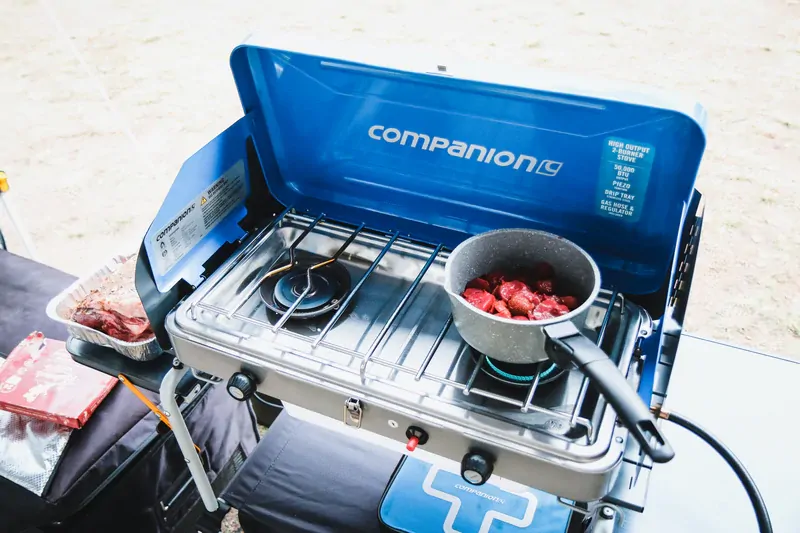
The Companion High Output 2 Burner Stove puts out 25,000 BTU per burner, which gives it a combined 50,000 BTU across two burners. That is more than double the Coleman FyreKnight and the highest output of any stove in this comparison. If you need to boil a large pot of water fast or cook for a group, this is the stove that does it without asking you to wait.
The cooking area fits two large pots side by side. It weighs 5 kg, has a stainless steel drip tray, chrome-plated pot trivets, and piezo ignition for push-button starting. It ships with a 1,000 mm gas hose and regulator for direct connection to 3/8" BSP gas cylinders. Gas consumption sits at 524 g/hr per burner, so a 4 kg bottle will give you roughly 3.8 hours with both burners running flat out. Dimensions are 590 x 280 x 110 mm.
The trade-off for that raw heat output is a simpler feature set. The flip-up lid doubles as a rear windbreak, but it does not offer the same 360-degree protection as the Coleman's WindBlock system. There are no interchangeable cooking surfaces and no carry bag. This is a stove that does one thing and does it well: produce a lot of heat in a compact footprint. If you camp in consistently windy conditions, pairing it with a fold-out aluminium windshield on the exposed sides will help keep the flame where it belongs.
Key features:
- 25,000 BTU per burner for fast boiling and high-heat cooking
- Piezo ignition for matchless starting
- Stainless steel drip tray and chrome-plated trivets
- Includes 1,000 mm hose and regulator
This stove suits car campers and groups who want maximum heat output in a straightforward, no-frills package.
Coleman Hyperflame FyreKnight: Wind Protection Built In
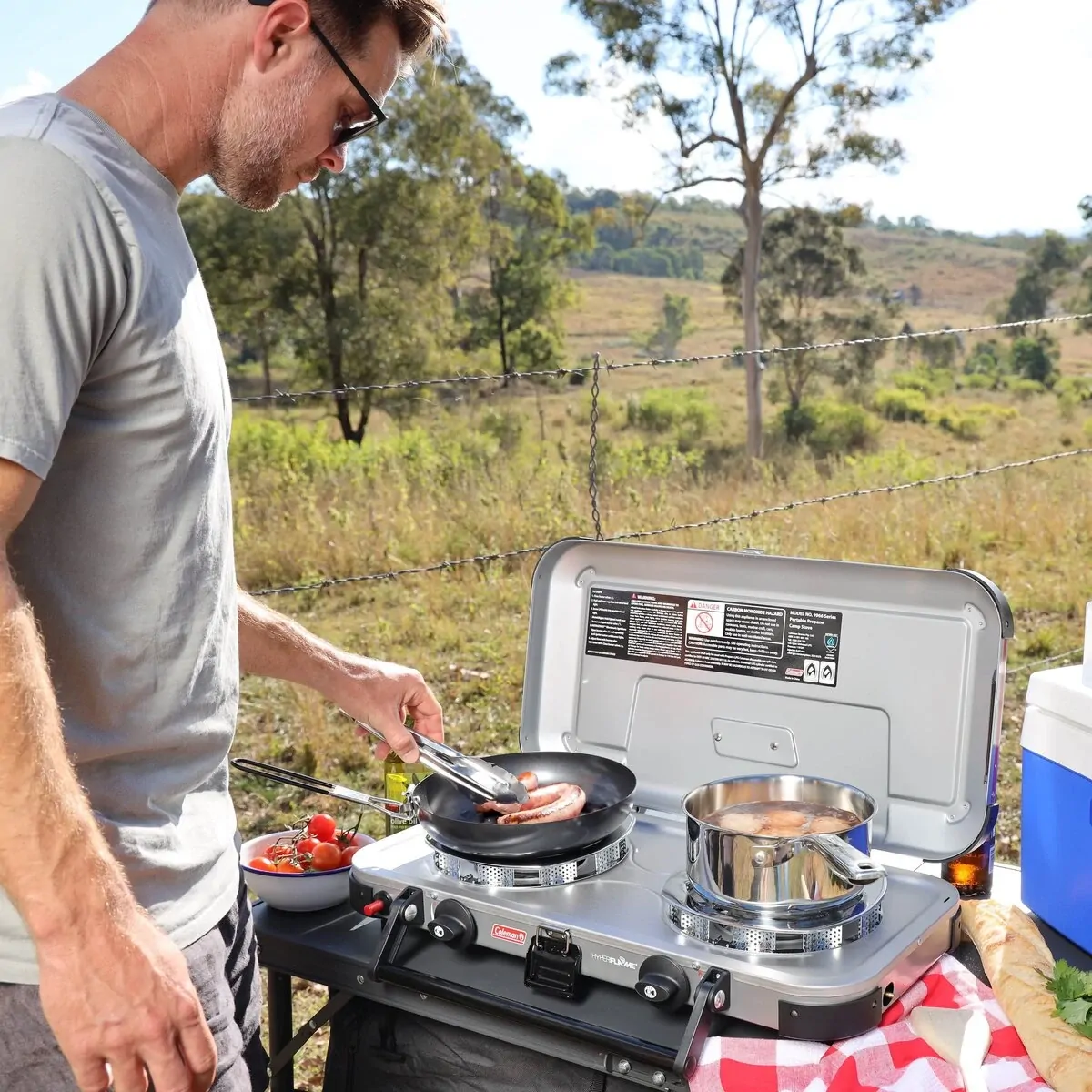
The Coleman Hyperflame FyreKnight produces 24,000 BTU across two independently adjustable burners (12,000 BTU each). On paper, that is less than half the Companion's output. But the FyreKnight's real advantage is keeping that heat where it belongs: under the pot.
The WindBlock pot supports provide 360-degree wind protection built directly into the burner housing. Unlike bolt-on windshields that rattle loose or get left in the car, these are structural. The downward stair-stepping burner design reduces the flame's exposure to crosswinds. Coleman claims it boils water twice as fast as a conventional burner, and in wind, that gap widens further because unprotected stoves lose so much heat sideways. The stove fits two 30 cm pots side by side, weighs 7.1 kg, and connects to LPG bottles via a 3/8" fitting with the included regulator.
The trade-off is simmer control. Forum feedback consistently notes that the FyreKnight runs hot, and dialling it back to a true low flame can be difficult. If your camp cooking leans toward boiling water, frying, and heating large pots quickly, this stove is hard to beat. If you want to simmer a curry for 30 minutes without burning the bottom, you will need patience and practice with the controls.
Key features:
- InstaStart push-button ignition, no matches needed
- PerfectFlow pressure control for consistent output in variable weather
- Aluminium cooktop with removable pan supports for cleaning
- Heavy-duty locking latches and shock-absorbing bumpers
This stove suits families who cook in exposed or windy campsites and want reliable heat without fussing with separate windshields.
Dometic Cadac 2 Cook 3 Pro Deluxe: The Versatile Griller
.webp)
The Dometic Cadac 2 Cook 3 Pro Deluxe takes a different approach entirely. Instead of chasing maximum BTU, it focuses on cooking versatility. Each burner produces 6,850 BTU for a combined 13,700 BTU, which is moderate compared to the Companion or Coleman. But the stove ships with interchangeable ceramic-coated grill plates (one flat, one ribbed), two pot stands, and a coffee pot stand. You can grill steaks on one burner while boiling water on the other, then swap in a pot stand for the evening's pasta.
The Cadac system is part of Dometic's modular range, so additional accessories like paella pans and pizza stones fit onto the same burner base. Two removable windshields slot onto the sides, and the lid itself doubles as a third wind barrier. The gas button protection requires a press-and-turn action to open the gas supply, which is a practical safety detail if children are around camp. Piezo ignition handles starting on both burners. Dimensions sit at 569 x 308 x 90 mm, the unit weighs 6.5 kg, and the whole package comes with a carry bag.
The stove runs on LPG at 30 mbar operating pressure and uses an LCC27 gas fitting with a 1/4" BSP burner connection. Gas consumption sits at 294 g/hr per burner, so 588 g/hr with both running flat out. That is roughly half what the Companion burns at full throttle. A 4 kg gas bottle gives you close to 7 hours of cooking on the Cadac at maximum output, compared to under 4 hours on the Companion. On longer trips with a single bottle, that efficiency adds up.
One thing to note: this stove does not have a flame failure device, so it cannot be legally connected to a caravan's bayonet gas system. It is designed for use with portable LPG bottles only.
If you want the Cadac as part of a complete camp kitchen setup, the Dometic X Outback Explorer Camp Kitchen Master Kit bundles it with a Smart Storage fry pan and a 3-piece nesting pot set with removable handles. The cookware stacks inside itself for compact storage in a caravan or canopy.
This stove suits campers who want to grill, fry, and boil on a single unit without carrying separate cookware for each task.
Jetboil Zip: The Solo Hiker's Workhorse
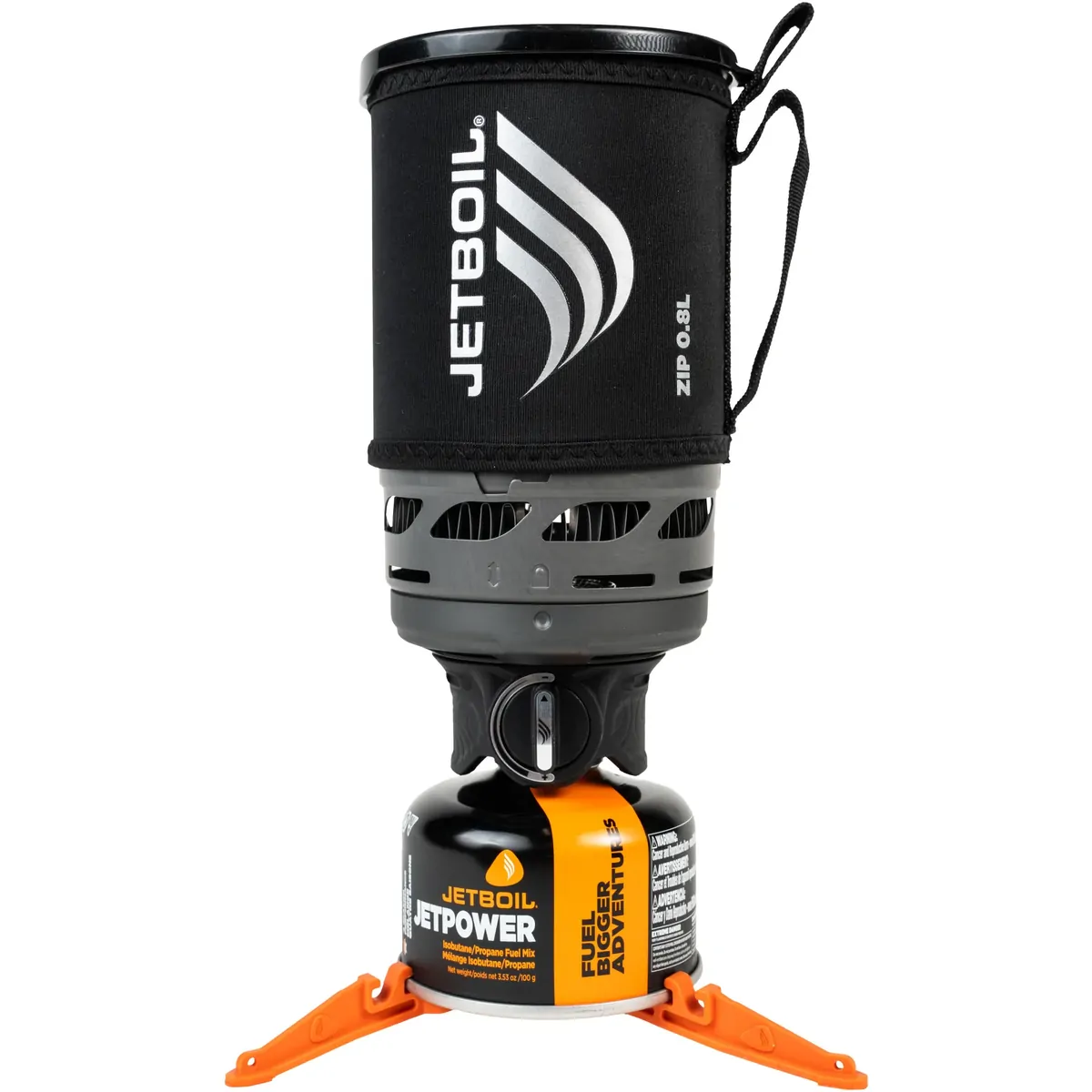
The Jetboil Zip is not a traditional camp stove. It is an integrated cooking system where the burner, pot, and wind protection work as a single unit. The 0.8-litre FluxRing cooking cup channels heat directly into the water, producing 4,500 BTU through a focused burner that boils 0.5 litres in 2 minutes 30 seconds. Jetboil rates the system at 12 litres boiled per 100 g of JetPower fuel, which is roughly half the fuel consumption of a standard canister burner. At 340 g and 104 x 165 mm, it packs down inside its own cup.
The system runs on isobutane/propane canisters (threaded type), which means it handles cold mornings better than straight butane. Note that the Zip uses match ignition, not piezo, so carry a lighter or matches. The included fuel canister stabiliser keeps the tall, narrow setup from tipping on uneven ground. The drink-through lid with pour spout and strainer handles coffee, tea, or draining pasta. The bottom cover doubles as a measuring cup and bowl.
The limitation is clear: this is a one-pot system built for boiling water. You are not frying eggs or grilling steak on a Jetboil Zip. But for solo hikers, bikepacking trips, or anyone who needs hot water fast and light, it fills a role that no two-burner stove can match. Jetboil also makes compatible accessories including a coffee press, pot support, and skillet if you want more cooking range on the trail.
This stove suits solo hikers, overnighters, and anyone who prioritises weight and speed over cooking range.
Which Camping Gas Stove Is Right for You?
The answer depends entirely on how you camp.
If you need raw heat to boil fast and cook big, the Companion High Output 2 Burner at 50,000 BTU combined is in a class of its own. If wind is your main enemy, the Coleman Hyperflame FyreKnight keeps 24,000 BTU working for you instead of blowing sideways. If you want a stove that grills, fries, and boils without extra cookware, the Dometic Cadac 2 Cook 3 Pro Deluxe is the most versatile unit in the range.
And if you hike? The Jetboil Zip at 340 g is in a different category entirely.
Can You Use a Gas Stove During a Total Fire Ban in Australia?
This question comes up on every camping forum, and the answer is not as simple as yes or no. Rules vary by state and can change daily.
In Victoria, the CFA permits commercially manufactured portable gas stoves during a Total Fire Ban, provided the stove is on stable ground, at least 3 metres from flammable material, with 10 litres of water ready and an adult present at all times. In NSW, the rules are tighter. NSW National Parks generally prohibit visitor-owned gas and electric cookers during fire bans unless you contact the local park office for permission in advance. Gas stoves are permitted within a caravan or three-sided enclosed annexe.
The safest approach: check your state's fire authority before every trip. Conditions change, and what was allowed last weekend may not be allowed this weekend. Bookmark the NSW RFS or CFA Victoria pages on your phone before you leave.
Frequently Asked Questions About Camping Gas Stoves
How long does a gas canister or bottle last on a camping stove?
It depends on the stove's gas consumption rate and heat setting. A standard 220 g butane canister lasts roughly 1.5 to 3 hours depending on whether you run the burner on high or low. With a propane/LPG setup, a 2 kg bottle will cover a weekend trip for two people comfortably. A 4 kg bottle suits a family for a week of regular cooking. For reference, the Companion High Output 2 Burner consumes 524 g/hr per burner at full output, so running both burners flat out would drain a 4 kg bottle in under 4 hours. In practice, you rarely run both on maximum for the entire cook, so a 4 kg bottle goes further than the maths suggest.
Why does my camping stove struggle on cold mornings?
If you are running straight butane, it stops vaporising effectively below about 0.5°C. The canister feels full, but the gas will not flow. This is a physics problem, not a stove problem. The fix is to switch to a propane/LPG setup for winter camping, or use isobutane/propane blend canisters (like those from Jetboil or MSR), which remain functional down to around -12°C. Keeping a butane canister inside your sleeping bag overnight can help it perform better first thing in the morning, but it is a workaround, not a real fix for sustained cold weather.
What is the difference between LCC27 and 3/8" BSP gas fittings?
LCC27 (Type 27) is the current Australian standard for portable LPG cylinder connections. It replaced the older POL fitting in 2022. A 3/8" BSP fitting is a general-purpose thread used on many stove regulators and hoses. Some stoves ship with an LCC27 regulator ready to connect directly to a standard Australian gas bottle. Others use a 3/8" fitting and require a separate regulator or adapter. Check before you buy, and carry the right adapter if your bottle and stove do not match.
Do I need a windshield for my camping gas stove?
If you camp in any location that gets a breeze, yes. Wind strips heat from the bottom of your pot before it can transfer to the food, which wastes fuel and extends cooking time. Stoves with built-in wind protection (like the Coleman FyreKnight's WindBlock system) handle this by design. For stoves without built-in protection, a fold-out aluminium windshield costs under $20 and pays for itself in fuel savings within a few trips.
Can I use a camping gas stove inside my tent or camper trailer?
No. Portable gas stoves release carbon monoxide as they burn fuel. In an enclosed space, CO builds up quickly and is odourless. This applies to tents, fully sealed camper trailers, and any space without strong cross-ventilation. If you must cook in a sheltered area, use an open-sided annexe or cook under a tarp with open sides. A CO detector is a worthwhile addition to any camp setup where you cook near sleeping areas.
Build Your Camp Kitchen
A stove is one piece of the setup. Browse our full range of camping cookware, gas stoves, and hiking cooking gear to round out your kit. All orders ship Australia-wide.

Leave a comment