
Best 270 Degree Awnings in Australia: 4 Compared (2026)
A standard side awning gives you a strip of shade along one wall of your vehicle. By early afternoon the sun has swung past it and you are dragging your camp chair around the vehicle to stay out of the heat. A 270 degree awning wraps around the side and rear of your 4WD, keeping that tailgate area shaded all day. Your fridge slide, your drawers, your camp kitchen. All under one continuous cover.
That rear wrap also eliminates the wet run between the passenger door and the back of the vehicle during a downpour. Instead of sprinting through rain to grab something from the drawers, you walk under cover the entire way. For touring in the Top End, Cape York, or anywhere afternoon storms roll in without warning, that changes how you use your campsite.
We stock four 270 degree awnings at Outback Equipment. Each one sits at a different point on the weight, coverage, and feature spectrum. This guide breaks down the specs that actually matter, then compares all four so you can pick the right one for your rig.
What to Look for in a 270 Degree Awning
Before comparing products, understand the criteria that separate a reliable awning from one that lets you down on the third trip. These are the benchmarks we used to assess every product below.
1. Canvas Weight and Waterhead Rating
Canvas weight is measured in grams per square metre (gsm). Most quality 270 awnings sit between 280gsm and 320gsm. At 280gsm the canvas is lighter and adequate for regular touring. At 320gsm the weave is denser, more abrasion resistant, and holds up better over years of UV exposure and repeated wet/dry cycles.
Waterhead rating tells you how much water pressure the fabric withstands before it leaks. A 2000mm rating handles standard rain. A 3000mm rating handles the kind of sustained tropical downpour you get crossing the Daintree in January or camped on the Mitchell River during the build-up. If your touring takes you north of Rockhampton in the wet months, prioritise 3000mm.
2. Freestanding vs Pole-Supported
A freestanding awning is a self-supporting outdoor canopy that can be set up quickly without the need for vertical support poles or guy ropes in calm weather. Depending on the model they still need to be tied back and some require poles, but they are largely self-supported. "Freestanding" in the outdoor industry usually means "pole-less in perfect conditions" rather than completely hands-off.
Pole-supported models use telescopic legs that must be positioned each time you set up. They weigh less and cost less, but add minutes to every setup and create obstacles around your campsite. If you move camp daily or set up solo after a long drive, freestanding is worth the extra weight.
3. Wind Rating
This is the spec most buyers overlook until the first gusty afternoon at camp. A freestanding awning without poles pegged is typically rated to 25 to 30 km/h. Above that, you need the support poles deployed and guy ropes staked. All four awnings in this guide include poles and ropes for when conditions pick up, and you should always have them ready to deploy at camp.
4. Integrated LED Lighting
Most 270 awnings now include LED strips in the rafter arms. The feature that makes a real difference is dual-colour output. White light for cooking and task work, amber or warm white to reduce insect attraction once you are settled for the night. Insects are drawn to blue and ultraviolet wavelengths. Amber sits outside that range and pulls in measurably fewer moths and mosquitoes. If the LEDs run off USB, you can power them from a small power bank rather than wiring into your vehicle.
5. Coverage Area and Weight
Coverage ranges from 11m² to nearly 14m² across these four products. Larger footprint means more shade, but also more weight sitting permanently on your roof rack. The spread here is 26kg to 30.6kg for the awning alone, and once you add mounting brackets the total installed weight climbs further. The Tuff Terrain, for example, weighs 26.19kg for the awning plus 3.82kg for brackets, bringing the installed total to just over 30kg. Every kilogram on the roof raises your centre of gravity, so weigh coverage against payload carefully.
Full Comparison Table
| Spec | Tuff Terrain 270 | RAXAR 270 Freestanding | Outback Tourer 270 Plus | Campboss BOSS Shadow 270 XL |
|---|---|---|---|---|
| Canvas | 320gsm Poly-Cotton | Polycotton (3000mm rated) | Polycotton Ripstop | 280gsm Waterproof Canvas |
| Waterhead | Not listed | 3000mm | 3000mm | 3000mm |
| Coverage | 11.14m² | 270° x 2m projection | 13.8m² | Not listed |
| Weight | 26.19kg (+ 3.82kg brackets) | 28kg | 30.6kg | 28kg |
| Freestanding | Yes (3 pre-mounted + 3 extra poles) | Yes (A-frame, poles & ropes included) | Yes (3 built-in legs) | Yes (A-frame arms) |
| LEDs | 4 x dimmable (white & amber, USB) | Dual-colour strips (USB) | 4 x warm-colour strips (USB) | Dimmable white to orange (USB) |
| Frame | 6063 aluminium | Box aluminium A-frame | Aluminium, welded to backplate | A-frame arm system |
Tuff Terrain 270 Free Standing Awning With Dimmable LEDs
.webp)
Everything in the box, nothing left to source.
The Tuff Terrain 270 is probably the best option for wanting to get set up with everything right from the get-go..
Inside the box you get three heavy-duty L-brackets, six Uni-Strut nuts for platform rack channels, six U-bolts with nuts and washers for crossbar mounting, and a 13mm ratchet spanner sized specifically for tightening in tight spaces between the rack and the roof. That ratchet spanner is a small inclusion that saves real frustration on install day when a standard socket cannot reach.
The frame uses 6063 aluminium, an alloy grade selected for its strength-to-weight ratio in structural applications. The 320gsm poly-cotton canvas puts it at the heavier end of the fabric spectrum, which translates to better abrasion resistance and longer life under sustained UV. Six twist-lock aluminium poles split into two groups: three pre-mounted on ball joints for quick freestanding deployment, and three stored in a canvas bag for extended support when wind picks up. Thirteen ratchet tie-down ropes and thirteen pegs complete the securing system.
LED lighting covers four strips with dimmable white and amber modes, powered via a 3m USB cable with control switch. White for general camp use and cooking. Amber for low-impact lighting after dark when the moths start circling. The dimmer lets you dial right down to a soft glow once you are settled in for the night.
Coverage: 11.14m². Weight: 26.19kg (awning) + 3.82kg (mounting brackets). Extended dimensions: 5.95m long x 4m wide with a 2m outward projection from the vehicle. Mounting is versatile: the L-brackets attach to most standard crossbars, and the Uni-Strut nuts slot directly into the channels on platform racks from Rhino-Rack, Rola, and similar brands.
Best for: Buyers who want a complete, ready-to-mount kit with no extra purchases required. The Uni-Strut compatibility, included ratchet spanner, and 320gsm canvas make it a strong all-rounder, particularly for platform roof rack owners fitting a 270 awning for the first time.
RAXAR 270 Freestanding Awning
Heavy-duty transit protection and a complete hardware package.
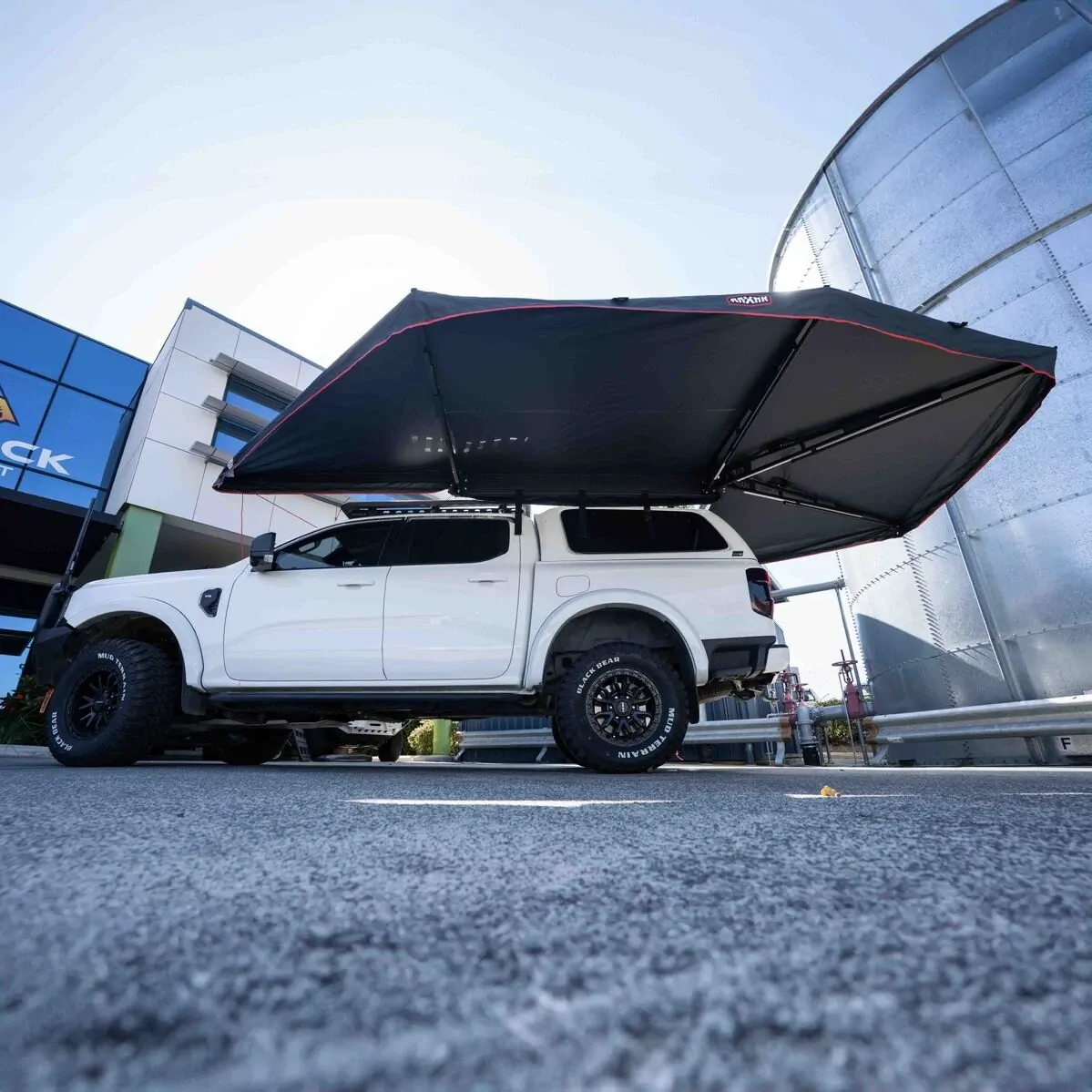
The RAXAR 270 Freestanding Awning is built around a box aluminium A-frame with 304 stainless steel hardware throughout. That combination gives you a rigid, corrosion-resistant structure that holds up to coastal salt air and red dust equally well. The A-frame design provides lateral stiffness when the awning is deployed, reducing flex and movement in light breezes.
The polycotton canvas carries a 3000mm waterhead rating and UV50+ protection. Three of the four awnings in this guide hit the 3000mm mark, but RAXAR pairs it with an explicit UV50+ rating that confirms the fabric blocks over 98% of UV radiation. For touring in central and northern Australia where UV index regularly exceeds 11, that rating provides measurable protection.
Where the RAXAR separates itself is the transit cover. The 1000GSM PVC protective bag is substantially heavier duty than the fabric or canvas covers on most competitors. On corrugated roads where the awning cops constant vibration, road grime, and stone chips, a 1000GSM PVC cover keeps the canvas and frame protected between camps. That matters over thousands of kilometres when the cover is the first line of defence against damage.
Integrated dual-colour LED light strips connect via USB, giving you switchable white and amber modes. Storm poles adjust to 2.6m, suiting lifted vehicles and canopy setups, and guy ropes are included for when conditions get breezy. All mounting brackets and installation hardware come in the box.
Weight: 28kg. Coverage: 270° arc with a 2m projection from the vehicle.
Where it falls short: No canvas gsm figure is published, so you cannot directly compare fabric density against the 320gsm Tuff Terrain or Outback Tourer. No specific coverage area in square metres is listed either, which makes footprint comparison less precise. The 28kg weight is mid-range but sits above the Tuff Terrain's 26.19kg awning weight.
Best for: Tourers who cover serious distances on rough roads and want the heaviest-duty transit protection in this lineup. The 1000GSM PVC cover, 304 stainless hardware, and 3000mm waterhead rating make it a strong choice for extended trips through remote Australia where the awning spends as much time packed up on corrugations as it does deployed at camp.
Outback Tourer 270 Plus Freestanding Awning
Maximum coverage with a welded frame.
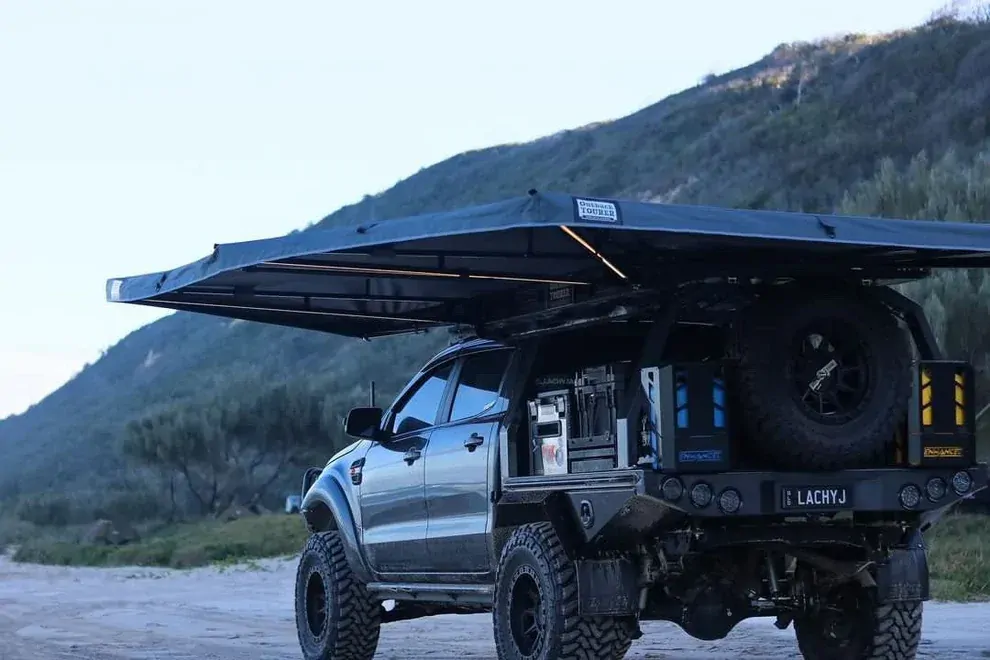
The Outback Tourer 270 Plus leads this comparison on raw shade. At 13.8m² it covers over 2.5m² more ground than the Tuff Terrain and offers the largest sheltered footprint of any 270 awning in our range. If you travel with family, run a full camp kitchen off the tailgate, or add awning walls to create an enclosed living space, that extra footprint changes how your campsite works.
The frame is welded to the backplate rather than riveted. This is a meaningful construction difference. Riveted joints are a known failure point on awnings subjected to vibration from corrugated roads. Over thousands of kilometres on the Gibb River Road or the Plenty Highway, rivets can work loose and eventually shear. A welded joint eliminates that failure mode. The arms use black aluminium double truss construction with stainless steel bolts and nuts throughout.
Four LED strip lights are set to a warm colour temperature and run off USB. The warm tone is a deliberate insect management choice. You get less bug activity under warm light compared to cool white. The trade-off is you do not get a switchable bright white mode for detailed task lighting at the camp kitchen.
Four rain arms create water runoff channels, and four included guy ropes let you manage pooling during sustained rain. Three built-in legs make it freestanding. Closed dimensions are 2260 x 250 x 200mm.
Weight: 30.6kg. That is the heaviest in this comparison by a clear margin and reflects the welded construction and thicker material. Polycotton ripstop canvas with a 3000mm waterhead rating.
Where it falls short: At 30.6kg this awning eats into your GVM budget. On a 200 Series or Patrol that is manageable. On a Ranger or Hilux already carrying a canopy, drawers, and a fridge, 30.6kg on one side of the roof rack needs careful consideration. The warm-only LEDs mean you will likely want a separate white camp light for cooking tasks.
Best for: Families and group tourers who want the largest sheltered area. If you run awning walls to create an enclosed camp space, the 13.8m² footprint gives you room to set up a table, chairs, and a swag underneath with space to move.
Campboss BOSS Shadow 270 XL Awning
.webp)
Quick-release setup with stainless hardware for coastal rigs.
The Campboss BOSS Shadow 270 XL uses a full A-frame arm system for lateral rigidity when deployed. Each arm carries a built-in adjustable leg at 260cm, longer than most competitors, suiting high-lift vehicles and canopy setups where clearance between the rack and the ground is generous.
All bolts, nuts, and washers are 304 stainless steel. This grade of stainless resists corrosion from salt spray and coastal air, which matters if you tour the coast, launch boats, or camp near the beach regularly. Standard zinc-plated hardware corrodes quickly in those environments. The mounting brackets are longer than standard, providing a firmer grip on wider roof rack crossbars.
The 280gsm waterproof canvas carries a UV 50+ rating and a 3000mm waterhead rating, matching the RAXAR and Outback Tourer for rain resistance. LED lighting is dimmable and adjustable from white through to orange via a 3m USB cable. Quick-release rope ratchets handle setup and pack-down, and Campboss states the awning is built for solo setup.
Weight: 28kg.
Where it falls short: The 12-month warranty is the shortest in this comparison. That gap is significant on a product that lives on your roof permanently and cops UV, vibration, dust, and rain every trip. No total coverage area is published on the product page, which makes footprint comparison against the others less precise. The 280gsm canvas is lighter duty than the 320gsm fabric on the Tuff Terrain and Outback Tourer, so expect a shorter lifespan under sustained UV exposure.
Best for: High-lift vehicles and canopy builds where the 260cm poles and A-frame arm rigidity add genuine structural value. The quick-release rope ratchets speed up setup and pack-down for solo travellers. A strong choice for coastal touring where the 304 stainless hardware earns its keep against salt corrosion.
Which 270 Degree Awning is Right for You?
The right awning depends on where you travel, how long you stay, and what your rig can carry.
Choose the Tuff Terrain 270 if you want everything in the box on day one. Complete mounting kit with Uni-Strut nuts, 6063 aluminium frame, 320gsm canvas, and dimmable dual-colour LEDs. Our OEM pick and the strongest all-round value in the range.
Choose the RAXAR 270 Freestanding if you cover big distances on rough roads and want the heaviest-duty transit protection available. The 1000GSM PVC cover, 304 stainless hardware, and 3000mm waterhead rating are built for extended remote touring.
Choose the Outback Tourer 270 Plus if maximum shade coverage is your priority. At 13.8m² with a welded frame, it is built for families and group setups who want room to add walls and create an enclosed camp space.
Choose the Campboss BOSS Shadow 270 XL if you run a high-lift rig or tour the coast. The A-frame arms, 260cm poles, quick-release ratchets, and 304 stainless hardware suit builds where clearance, speed of setup, and corrosion resistance matter most.
Frequently Asked Questions
Can one person set up a 270 degree awning?
All four awnings in this guide are freestanding and designed for solo setup. You unzip the transit cover, swing out the rafter arms until they lock, and the awning holds itself up. With practice, deployment takes under two minutes. Pack-down follows the same steps in reverse. The first time takes longer while you learn the sequence, but by the second or third trip it becomes routine.
Do I need to peg a freestanding 270 awning every time?
In calm conditions, no. The rigid arms hold position without ropes or pegs. But conditions change fast in Australia. A gust front ahead of an afternoon storm can hit 40 to 60 km/h with very little warning. Always carry pegs and ropes as standard kit, and deploy them whenever wind picks up or you are leaving the awning unattended. All four awnings in this guide include poles and ropes for exactly this reason.
What is the difference between 280gsm and 320gsm canvas?
The gsm figure reflects fabric density. At 280gsm the canvas is lighter, which helps if weight is a concern. At 320gsm the weave is tighter, resists abrasion better, and holds up longer against repeated UV exposure and wet/dry cycles. If you tour frequently or leave the awning deployed for multiple days at a time, 320gsm will outlast 280gsm. If you tour a few weekends a year and pack the awning away each time, 280gsm is adequate.
Will a 270 awning fit my roof rack?
Most 270 awnings mount to standard crossbar racks using L-brackets or universal hardware. Platform racks like the Rhino-Rack Pioneer or Rola Titan use channel-mount systems with Uni-Strut or T-bolt fittings. The Tuff Terrain includes Uni-Strut nuts for this purpose. Before purchasing, check two things: your rack's dynamic weight rating (a 270 awning with brackets adds 26 to 31kg of static load to one side, and dynamic forces on corrugated roads multiply that figure), and available mounting space on the passenger side of the rack.
Why do some awnings only have warm LEDs instead of white?
Insects are most attracted to light in the blue and ultraviolet spectrum. Warm and amber light falls outside this range and pulls in fewer moths, mosquitoes, and beetles. The Outback Tourer 270 Plus uses warm-only LEDs as a deliberate insect management choice. The Tuff Terrain, RAXAR, and Campboss offer switchable white and amber modes, giving you bright white for cooking tasks and amber once you are settled. If you camp near water or in bushland during warmer months, the amber mode makes a noticeable difference.
Passenger side or driver side?
Passenger side (left hand side) is the most common configuration. It keeps the awning away from the road when you pull off onto the left shoulder, and it wraps shade around the rear of the vehicle where most camp kitchens and fridge setups sit. Choose driver side only if your vehicle layout, camp orientation, or a rooftop tent entry point specifically requires it. All four awnings in this guide are available in passenger side.
Browse the full 270 degree awning range at Outback Equipment, or explore the complete awning collection including side awnings, pull-out models, and awning walls. Australia-wide delivery.

Leave a comment