My Car
Please select your vehicle
Run the numbers before you pack. Four questions gets you the litres you need for drinking, cooking and washing, what that weighs once it is in the vehicle, and what to carry it in.
Fill in the form to see your result.
Assumes normal camp cooking, a basic daily wash and a 20 percent safety margin. Travelling with a dog? Add about 2L a day. Refilling along the way? See below for how to adjust. A planning guide, not a survival guarantee.
About 5 litres per person per day is the figure most Australian tourers plan around. That covers drinking, cooking and a basic wash in mild conditions. Once it gets hot, or you want to wash properly, it climbs.
The calculator splits that total into its parts, because the parts behave differently. Drinking water rises with heat and is the part worth having spare. Cooking and washing water is where most of the savings are. Showers are optional, but they are the biggest single lump on most trips.
| Conditions | Drinking | Cooking & dishes | Basic wash | Daily total |
|---|---|---|---|---|
| Mild, under 25°C | 2L | 1.5L | 1L | 4.5L |
| Warm, 25 to 32°C | 3L | 1.5L | 1L | 5.5L |
| Hot, 32 to 38°C | 4L | 1.5L | 1L | 6.5L |
| Extreme, over 38°C | 5.5L | 1.5L | 1L | 8L |
Kids drink a bit less than adults but use the same cooking and washing water. Dogs need roughly a litre per 10kg of body weight per day, so add about 2L a day for a medium dog.
Most of us drink less at home than we think we do on the road. A day in the car with the heat, the dust and a few coffees adds up quickly, so the trip figure will usually be higher than your normal. Round up rather than down and you will not think about it again.
This is the part that catches people out. Water is heavy, it sits high or far back in most setups, and every litre of it is subtracted from the load your vehicle is legally allowed to carry.
A litre of fresh water weighs one kilogram. So 80 litres is 80kg, which is roughly the same as putting another adult in the vehicle for the whole trip. On a dual cab ute with a canopy, a fridge, recovery gear, tools and a couple of jerries of fuel, 80kg is often the difference between being legal and being over your GVM.
| Water carried | Weight | Roughly the same as |
|---|---|---|
| 20L jerry can | 20kg | A full recovery kit |
| 40L footwell tank | 40kg | A large fridge, loaded |
| 80L | 80kg | An extra adult passenger |
| 150L | 150kg | Two adults, or a rooftop tent plus awning plus bedding |
| 200L underbody tank | 200kg | Most of a dual cab’s remaining payload |
Two practical rules follow from that. First, check the payload figure on your vehicle’s compliance plate and work out what you actually have spare before you decide on tank size. Second, mount water low and between the axles wherever you can. An underbody or footwell tank changes how the vehicle handles far less than the same volume in jerry cans on a roof rack.
If you are towing, remember the van has its own limits. A full 95L van tank is 95kg of ball weight and axle load that has to be inside your ATM, and water sloshing in a half full tank moves around while you drive.
Most well sorted setups use more than one. The reason is redundancy, not capacity. If all your water is in one tank and that tank splits on a corrugated road, the trip is over.
| Type | Typical size | Best for | Watch out for |
|---|---|---|---|
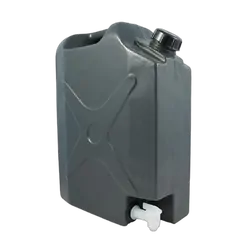
| Jerry cans | 10 to 25L | Redundancy, easy refilling, carrying water to camp | Heavy to lift when full, take up load space, need proper mounting |
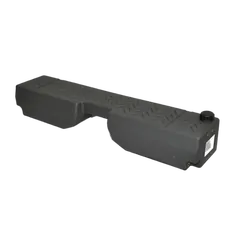
| Footwell tanks | 40 to 45L | Adding capacity low and central in a dual cab | Vehicle specific fit, usually needs a pump or tap kit |
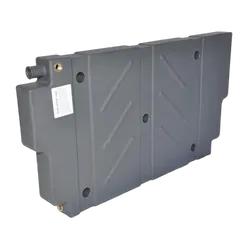
| Underbody tanks | 15 to 200L | Serious capacity without using load space | Ground clearance, stone damage, needs guarding on rough tracks |
| Bladders | 20 to 150L | Flexible extra capacity you can pack away empty | Puncture risk, must sit on a smooth surface, hard to secure |
| Drink bottles & hydration packs | 0.5 to 3L | Day use, walks, keeping track of what you personally drink | Not a storage solution, purely for access |
Split your water across at least two containers and keep one 20L jerry sealed as an emergency reserve you do not touch. Run your day to day water from the tank, refill drink bottles from a tap or pump, and keep a filter inline so you can top up from a bore or a town supply you are not sure about.
Label your water jerries clearly and never use a container that has held fuel. Jerry cans for water are food grade plastic and usually blue or white for exactly this reason.
A starting point across the range, from a cheap cube for a weekender through to an undertray tank for extended remote travel.
Worked examples using the same numbers as the calculator, including the 20 percent margin. Where a trip has reliable refill points, the figure shown is what you carry at any one time rather than the whole trip total.
If you can refill along the way, you only need to carry enough for the longest leg between refills. Put the days in that leg into the calculator rather than the whole trip, then add a bit for the drive to the next tap. A fortnight on the Canning is not 380 litres on board, it is about five days at a time between wells.
| Trip | Who and how long | Conditions | Water on board |
|---|---|---|---|
| Coastal weekender | 2 people, 2 days | Mild, no showers | About 20L |
| Family long weekend | 4 people, 3 days | Warm, no showers | About 80L |
| Simpson Desert crossing | 2 people, 6 days | Hot, no showers | About 95L |
| Cape York in the dry | 2 people, longest leg 4 days between refills | Hot, showers every few days | About 90L on board |
| Canning Stock Route | 2 people, longest leg 5 days between wells | Hot, showers every few days | About 135L on board |
You will see rules of thumb that put a Simpson crossing at 60 to 80 litres for two people, and plenty of people do it on that. Those figures assume lean use, not much washing and no margin. The numbers here include both, which is why they come out a bit higher. An extra 20 litres costs you 20kg of payload and buys a fair bit of breathing room, so it is usually worth it.
Every refill point you can rely on is water you do not have to carry. Planning your route around them is the single most effective way to cut weight.
An inline filter on your tank outlet handles sediment and improves taste, and a silver impregnated or ceramic element will deal with most bacteria. That is enough for treated town water you are not sure about, or a good bore. For surface water from a creek or dam, filter it and then boil it or use purification tablets. Filtering alone does not make questionable surface water safe.
Note that filters do not remove salt or dissolved minerals. If a bore is brackish, no amount of filtering will fix it, and drinking heavily saline water will dehydrate you faster than drinking nothing.
If the calculator has given you a number your vehicle cannot carry, these are the levers, roughly in order of how much they save.
Cut the washing, the cooking and the showers before you cut what you drink. If the numbers only work by drinking less, it is worth shortening the leg or finding a refill point instead.
Plan on about 4.5 litres per person per day in mild conditions, covering drinking, cooking and a basic wash. In hot weather that rises to around 6.5 litres, and over 38 degrees or on physically hard days it is closer to 8 litres. Add roughly 12 litres for every camp shower on top of that.
It is enough to drink, but not enough to also cook and wash with. Four litres is the figure to use when you are working out how long an emergency reserve would last. For actual trip planning, allow about 4.5 litres per person per day in mild weather and more in the heat, because that total has to cover the kettle and the washing up as well.
Fresh water weighs one kilogram per litre. So a 20 litre jerry can is 20kg, a 40 litre footwell tank is 40kg and a 200 litre underbody tank is 200kg once full. That weight comes directly off your vehicle’s payload, so check your compliance plate before deciding on tank size.
For two people over about six days in hot conditions with no showers, plan on roughly 95 litres including a safety margin. Plenty of people cross on 60 to 80 litres, which works if you are lean with the washing up, but it leaves little spare if soft sand or a breakdown adds a day.
Sometimes, but never assume it. Bore water quality varies from perfectly drinkable to heavily mineralised and undrinkable. Taste a small amount before filling your tanks, and use an inline filter. Filters improve taste and remove sediment and most bacteria, but they do not remove salt or dissolved minerals, so brackish water stays brackish.
Most well sorted setups use both. A fixed tank gives you capacity low in the vehicle without eating load space, and jerry cans give you redundancy plus the ability to carry water to camp and refill easily. Keeping at least one sealed 20 litre jerry as an untouched reserve is cheap insurance against a split tank.
Budget 12 litres for a typical camp shower. A pressurised or 12V camp shower with a trigger nozzle uses closer to 8 litres, while a gravity bag hung in a tree can easily run to 15 or 20 litres if you are not disciplined about turning it off.
About one litre per 10kg of body weight per day, so roughly 2 litres for a medium dog and 3 or more for a large one. Add a bit in the heat or if the dog is running alongside the vehicle, and offer water at every stop rather than waiting for them to ask.
These figures are planning guidance based on common Australian touring conventions, not medical advice. What you actually need varies with body size, health, activity and how acclimatised you are. For remote trips, let someone know your route and expected return date and carry a way to call for help.

WITH HUMM
Shop up to $2,000.00 and pay only $61.54 per week for 6 months.
WITH UP TO 12 MONTHS TO PAY
Shop up to $3,000.00 and pay only $46.15 per week for 12 months.
All you need to qualify is:
1) To be over 18 years of age.
2) Be an Australian permanent resident.
3) Have a valid form of identification (Australian Drivers License; Aged Pension Card; or Veteran's Pension Card).
4) Payment Type in your name (credit, debit or bank account).
For more information and to get set-up today, call our local customer support team on 1300 854 185
*Minimum deposit of 20% required. Weekly payments are calculated on a rate excluding a 20% initial deposit. Terms and conditions apply.
{{rrp}}
RRP {{price}} SALE {{price}} MATES'