My Car
Please select your vehicle
List what you run, adjust the watts to match your own gear, and get the panel size you need. Every step of the working is shown, so you can check it.
Enter your numbers to see a result.
The only figure the calculator adds is a 30 percent allowance for regulator losses, heat and the panel not sitting square to the sun. Everything else is your own numbers. Please note this is just a guide.
The calculator fills in a typical figure when you pick an appliance, and you can type over it. Check the compliance plate or manual on your own gear where you can, because these vary a lot between models.
| Appliance | Average draw | Typical hours | Daily use |
|---|---|---|---|
| 12V fridge, 35 to 45L | 15 to 21W | 24 | 360 to 500Wh |
| 12V fridge, 50 to 65L | 20 to 28W | 24 | 480 to 670Wh |
| 12V fridge, 75 to 85L | 26 to 37W | 24 | 620 to 880Wh |
| LED camp lights | 5 to 10W | 4 to 6 | 25 to 60Wh |
| Phone and camera charging | 10 to 15W | 1 to 2 | 15 to 30Wh |
| Laptop | 45 to 65W | 1 to 2 | 60 to 130Wh |
| Water pump | 50W | 0.2 | 10Wh |
| Diesel heater, running | 15 to 35W | 6 to 8 | 100 to 250Wh |
| CPAP (no humidifier) | 30 to 60W | 8 | 240 to 480Wh |
| Starlink Mini | 25 to 40W | 8 to 12 | 250 to 450Wh |
| 12V TV | 30 to 45W | 3 | 100 to 135Wh |
| Inverter, 1000W (kettle, toaster) | 1,000W | 0.3 | 300Wh |
| Inverter, 2000W (microwave, air fryer) | 2,000W | 0.3 | 600Wh |
| Inverter, 3000W (induction cooktop) | 3,000W | 0.3 | 900Wh |
Fridges are the one to watch. A fridge rated at 45W does not draw 45W all day, because the compressor cycles on and off. Over 24 hours it averages far less, which is why the table gives an average rather than the rating on the plate. Enter the average against 24 hours.
Inverters are the other one. The 1000W, 2000W or 3000W on the box is the most it can supply, not what it draws. Enter the wattage of the thing you plug into it and be honest about the time, because it is usually minutes rather than hours. A kettle pulls 2,000W but only for the four minutes it takes to boil. Most inverters also draw 10 to 25W just sitting switched on, so add a line for that if you leave yours on all day.
Four common setups, at 12V with 5 hours of good sun, using the calculator's default figures for each appliance.
| Setup | Daily use | At 12V | Solar needed |
|---|---|---|---|
| 40L fridge, lights, phone charging | 496Wh | 41Ah | 150W |
| 60L fridge, lights, laptop, fan | 846Wh | 71Ah | 250W |
| 80L fridge, lights, TV, pump, diesel heater | 1,107Wh | 92Ah | 350W |
| Dual zone fridge, Starlink, induction, lights, TV | 2,344Wh | 195Ah | 750W |
Drop the sun hours to 3.5 for a southern winter and every figure above rises by about 40 percent.
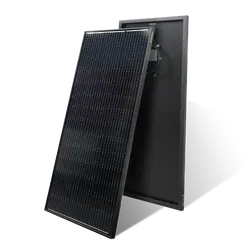
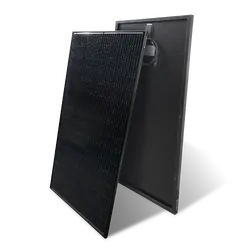
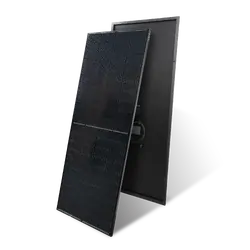
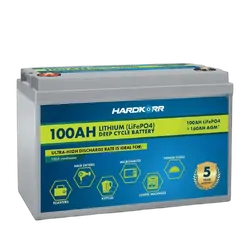
A spread across the range, from a single fixed panel for a weekender to a blanket and a battery to store it in.
It depends on what you run, but for a typical setup with a 40L fridge, lights and phone charging, that is about 500Wh a day, which needs roughly 150W of solar with 5 hours of good sun. Add a bigger fridge, a laptop and a fan and you are closer to 850Wh a day and 250W of solar. Most people camping with a fridge land between 150W and 350W.
A 40L fridge averages 15 to 21W over 24 hours, which is 360 to 500Wh a day, so about 100W to 150W of solar covers it with 5 hours of sun. A 60L fridge averages 20 to 28W, so 480 to 670Wh a day and 150W to 200W of solar. Use the average draw rather than the rating on the compliance plate, because the compressor cycles on and off.
Vans usually run a bigger fridge plus lighting, a water pump, a TV and often a diesel heater, which comes to roughly 1,100Wh a day. At 5 hours of sun that needs about 350W. Add Starlink and induction cooking and you are closer to 2,350Wh a day and 750W. Van panels are fixed flat on the roof, so if you often park in shade, size up.
Check the compliance plate, the manual or the power supply. If it lists amps instead of watts, multiply amps by volts, so 3A at 12V is 36W. For anything with a compressor or thermostat, like a fridge, use its average draw over the day rather than the rating, because it only runs part of the time.
Enter the wattage of whatever you plug into the inverter, not the rating of the inverter itself. A 2000W inverter running a 1000W toaster for six minutes is a 1000W appliance for 0.1 hours, which is 100Wh. The rating on the box is only the most it can supply at once. Inverters also draw 10 to 25W simply being switched on, so if yours stays on all day, add a separate line for that.
You can, but they are heavy loads and it is the minutes that matter, not the watts. A 2000W kettle for four minutes is only about 130Wh, which is less than a laptop uses in a day. An induction cooktop at 3000W for half an hour is 900Wh, which is more than most camping setups make in a day. Cooking on gas and keeping the inverter for the kettle and the coffee machine is far easier on your system.
Work out your daily use first, then allow for the fact you cannot use all of a battery's capacity. A 40L fridge with lights and phone charging uses around 500Wh, or 41Ah at 12V. A 100Ah lithium battery gives about 90Ah usable, so a bit over two days without any charge. The same 100Ah in AGM gives about 50Ah usable, so just over a day.
Discharging a battery fully shortens its life. Lithium (LiFePO4) is usually taken to about 90 percent of capacity, while AGM, gel and flooded lead acid should only go to about 50 percent. That is why a 100Ah lithium battery does roughly twice the work of a 100Ah AGM, and it is built into the reserve figure the calculator gives you.
A panel almost never delivers its rated output. The rating is measured in a lab at 25 degrees with the light square on the glass. In the field you lose output to heat, dust, cable and regulator losses, and to the panel not facing the sun directly. Thirty percent is a fair middle-ground allowance for an MPPT regulator. If you are on PWM, or the panel is flat on a roof and often shaded, allow more.
Around 5 hours a day is a fair figure for summer across most of Australia, and about 6 in the inland north. Southern winter drops to roughly 3.5 hours. These are not daylight hours, they are the equivalent hours of full-strength sun, which is why a long winter day in Victoria can still only be worth 3 or 4.
MPPT gets roughly 20 to 30 percent more out of the same panel, and it is the sensible choice above about 150W or if you are charging lithium. PWM is fine for a small maintenance panel keeping a battery topped up. The calculator assumes MPPT, so add to the result if you are running PWM.
These figures are planning guidance, not a guarantee of performance. Results depend entirely on the numbers you enter, and actual output varies with weather, cloud, shading, panel condition, cable losses, battery age and how your regulator is set up. Check the ratings on your own equipment, size up rather than down if solar is your only charging source, and have a licensed auto electrician install or verify any fixed 12V system.

WITH HUMM
Shop up to $2,000.00 and pay only $61.54 per week for 6 months.
WITH UP TO 12 MONTHS TO PAY
Shop up to $3,000.00 and pay only $46.15 per week for 12 months.
All you need to qualify is:
1) To be over 18 years of age.
2) Be an Australian permanent resident.
3) Have a valid form of identification (Australian Drivers License; Aged Pension Card; or Veteran's Pension Card).
4) Payment Type in your name (credit, debit or bank account).
For more information and to get set-up today, call our local customer support team on 1300 854 185
*Minimum deposit of 20% required. Weekly payments are calculated on a rate excluding a 20% initial deposit. Terms and conditions apply.
{{rrp}}
RRP {{price}} SALE {{price}} MATES'